Exothermic and endothermic reactions
Enthalpy
- Enthalpy (H) is the chemical energy stored in a substance.
- You cannot measure enthalpy itself, but you can measure the change in it during a reaction.
- is the enthalpy change of reaction — the energy taken in or given out.
- Its unit is .
The two kinds of reaction
| Exothermic | Endothermic | |
|---|---|---|
| Energy is | released to the surroundings | absorbed from the surroundings |
| Temperature of surroundings | rises — feels hot | falls — feels cold |
| Products compared with reactants | lower enthalpy | higher enthalpy |
| Sign of | negative (−) | positive (+) |
- The sign follows from where the energy went. In an exothermic reaction the products have less stored energy than the reactants, so the change is a decrease — negative.
Reading an enthalpy diagram
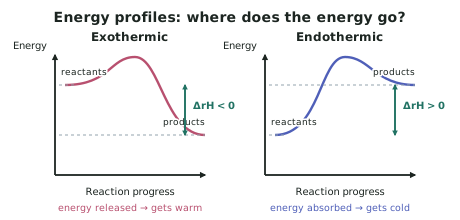
- The vertical axis is enthalpy; reactants are on the left and products on the right.
- is the vertical gap between the reactant level and the product level.
- Products lower than reactants → exothermic, negative.
- Products higher than reactants → endothermic, positive.
Everyday examples
Exothermic:
- Combustion — burning any fuel. Always exothermic.
- Neutralisation of an acid with an alkali.
- Respiration.
- Most reactions of metals with acids.
Endothermic:
- Thermal decomposition — heating limestone to make lime, for instance.
- Photosynthesis.
- Dissolving ammonium nitrate in water — this is how instant cold packs work.
Writing properly
- Always give the sign. A missing minus sign turns an exothermic reaction into an endothermic one.
- Always give the unit, .
- Write it beside the equation:
- If the equation is reversed, the sign of flips but the number stays the same.
The wording trap
- The reaction releases energy; the surroundings get hotter.
- So an exothermic reaction feels hot, but its is negative — because it is the chemicals that have lost energy.
- Students often reason "it got hotter, so energy went up, so positive". That is backwards: describes the chemicals, not the beaker.
Worked ExampleClassifying reactions and sketching a diagram
A student dissolves ammonium nitrate in water and records the temperature falling from 21.0 °C to 14.5 °C. In a second experiment, magnesium is added to hydrochloric acid and the temperature rises from 20.0 °C to 34.0 °C.
For each, state whether the reaction is exothermic or endothermic, give the sign of , and describe the enthalpy diagram.
Experiment 1 — dissolving ammonium nitrate
Step 1 — Read the temperature change. The temperature fell by 6.5 °C.
Step 2 — Decide where the energy went. The surroundings (the water) got colder, so they lost energy. That energy must have been absorbed by the chemicals.
Step 3 — Classify it. Energy absorbed by the chemicals → endothermic.
Step 4 — Give the sign. The chemicals gained stored energy, so the enthalpy change is an increase:
Step 5 — Describe the diagram. The products sit higher than the reactants, and is the upward gap between them.
Experiment 2 — magnesium with hydrochloric acid
Step 1 — Read the temperature change. The temperature rose by 14.0 °C.
Step 2 — Decide where the energy went. The surroundings got hotter, so they gained energy — which must have been released by the chemicals.
Step 3 — Classify it. Energy released → exothermic.
Step 4 — Give the sign. The chemicals lost stored energy, so:
Step 5 — Describe the diagram. The products sit lower than the reactants, and is the downward gap.