Melting and boiling points
The question to ask
To explain any melting or boiling point, ask one question:
What has to be overcome, and how strong is it?
- Strong forces holding the particles → high melting point.
- Weak forces → low melting point.
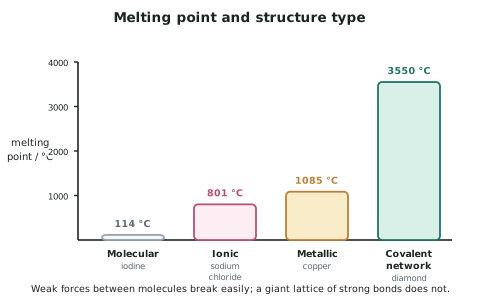
What is overcome in each structure
| Structure | What is overcome on melting | Strength | Melting point |
|---|---|---|---|
| Molecular | forces between the molecules | weak | low (often below 200 °C) |
| Ionic | electrostatic attractions throughout the lattice | strong | high (~600–2800 °C) |
| Metallic | attraction between the ions and the electron sea | strong | high (~650–3400 °C) |
| Covalent network | covalent bonds throughout the lattice | very strong | very high (>1500 °C) |
Typical values worth knowing as anchors:
- Iodine (molecular) — 114 °C
- Sodium chloride (ionic) — 801 °C
- Copper (metallic) — 1085 °C
- Diamond (covalent network) — 3550 °C
Molecular substances: what changes the melting point
Within molecular substances, the melting and boiling points still vary, and two factors explain it:
- Larger molecules attract each other more strongly → higher melting and boiling points.
- Down group 17: (gas) → (liquid) → (solid).
- Along a homologous series, boiling point rises steadily as the chain lengthens.
- Polar molecules attract each other more strongly than non-polar ones of similar size → higher melting and boiling points.
- Water (polar) boils at 100 °C; methane (non-polar, similar size) boils at −162 °C.
Ionic substances: what changes the melting point
- Higher ionic charges give stronger attractions and a higher melting point.
- ( and ) melts at 801 °C.
- ( and ) melts at 2850 °C — far higher, because the charges are doubled.
- This comparison is a very common Merit question.
The comparison that must be right
- Never say a molecular substance melts at a low temperature because "its covalent bonds are weak". The covalent bonds are strong — they are simply not the thing being broken.
- The correct statement is: only the weak forces between the molecules are overcome.
Worked ExampleComparing three melting points
Explain why sodium chloride (801 °C), magnesium oxide (2850 °C) and chlorine (−101 °C) have such different melting points.
Step 1 — Identify the structure of each
- Sodium chloride — metal + non-metal → ionic, a giant lattice of and .
- Magnesium oxide — metal + non-metal → ionic, a giant lattice of and .
- Chlorine — two non-metals, small formula, very low melting point → simple molecular, separate molecules.
Step 2 — Explain chlorine, the lowest
Chlorine consists of separate molecules with only weak forces between them. Melting overcomes those weak forces — the strong covalent bond inside each molecule is not broken.
Because the forces are weak, very little energy is needed, so the melting point is very low (−101 °C).
Step 3 — Explain the two ionic compounds
Both are giant ionic lattices. Melting requires overcoming strong electrostatic attractions between oppositely charged ions throughout the whole structure, which needs a large amount of energy — so both melt at high temperatures, hundreds of degrees above chlorine.
Step 4 — Explain the difference between them
The two ionic compounds differ in the charges on their ions:
- — and , charges of 1+ and 1−.
- — and , charges of 2+ and 2−.
Higher charges produce a stronger electrostatic attraction between the ions. The attractions in magnesium oxide are therefore much stronger than those in sodium chloride, so more energy is needed to separate the ions.
That is why magnesium oxide melts at 2850 °C while sodium chloride melts at 801 °C.