Forces between molecules
Two different things called "bonds"
This page exists because one confusion causes more lost marks than any other in this standard.
- Covalent bonds hold the atoms together inside a molecule. They are strong.
- Intermolecular forces attract separate molecules to each other. They are weak.
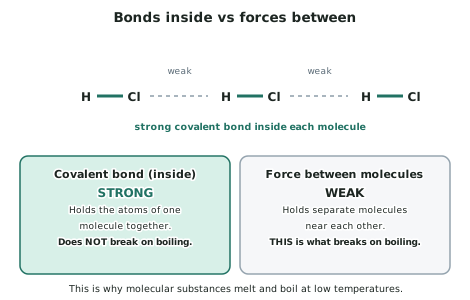
What breaks when a molecular substance melts or boils
- Only the weak forces between the molecules are overcome.
- The covalent bonds inside each molecule stay completely intact.
- The molecules simply move apart from one another — they are not taken apart.
Worked through for water boiling:
- Steam is still made of molecules. Each still has its two O–H covalent bonds.
- What has been overcome is the attraction between one water molecule and the next.
- Breaking the O–H bonds would give hydrogen and oxygen atoms, which is a chemical change, not boiling.
Why molecular substances melt at low temperatures
- The forces between molecules are weak, so only a small amount of energy is needed to separate them.
- That is why molecular substances are typically gases, liquids or low-melting solids at room temperature.
- Compare this with an ionic lattice or a covalent network, where melting means breaking strong bonds throughout a giant structure — which needs a great deal of energy.
What makes the forces stronger
Two things increase the strength of the attraction between molecules:
-
Bigger molecules attract each other more strongly than small ones.
- This is why boiling point rises down a homologous series, and why is a solid while is a gas.
-
Polar molecules attract each other more strongly than non-polar molecules of a similar size.
- This is why water (polar, tiny) boils at 100 °C while methane (non-polar, similar size) boils at −162 °C.
-
Stronger forces between molecules → higher melting and boiling points.
How much to say — and no more
You are not required to name or distinguish the types of intermolecular force. The standard says so explicitly, so:
- Do say: "forces between the molecules", "intermolecular forces", "intermolecular attractions".
- Do not try to identify them as dispersion forces, dipole–dipole attractions or hydrogen bonding. That is Level 3, earns nothing here, and creates chances to make a mistake.
Worked ExampleExplaining a difference in boiling point
Chlorine () is a gas at room temperature and iodine () is a solid, even though both are molecular substances made of two identical atoms. Explain this difference, and explain why melting iodine does not produce iodine atoms.
Step 1 — Identify the structure of both
Both are molecular substances: separate small molecules, with a strong covalent bond inside each molecule and weak forces between the molecules.
Step 2 — Identify what changes state
Melting or boiling a molecular substance means separating the molecules from each other, so what matters is the strength of the forces between the molecules — not the strength of the covalent bond inside.
Step 3 — Compare the molecules
An iodine molecule is much larger than a chlorine molecule — iodine is far lower in group 17, so its atoms have many more electrons.
Larger molecules attract each other more strongly, so the intermolecular forces in iodine are stronger than those in chlorine.
Step 4 — Link that to the states
- Chlorine — weak forces between small molecules, so very little energy is needed to separate them. They are separated at room temperature, so chlorine is a gas.
- Iodine — stronger forces between much larger molecules, so more energy is needed. At room temperature there is not enough, so the molecules stay held together and iodine is a solid.
Step 5 — Answer the second part
Melting iodine overcomes only the weak forces between the molecules, allowing them to move past one another.
The strong covalent bond inside each molecule is not broken, so molten iodine is still made of molecules, not iodine atoms. Splitting into atoms would be a chemical change requiring far more energy.