Shapes of simple molecules
Why molecules have a shape
- The pairs of electrons around the central atom are all negative, so they repel each other.
- They therefore spread out to get as far apart as possible.
- The positions they settle into determine the shape of the molecule.
This idea is all you need. Count the electron pairs, spread them out, and read off the shape.
The one rule that matters
Lone pairs repel more strongly than bonding pairs.
- A bonding pair is pulled between two nuclei, so it is held out of the way.
- A lone pair is held by only one nucleus, so it sits closer to the central atom and takes up more room.
- Each lone pair therefore squeezes the bond angle down by roughly 2.5°.
The five shapes
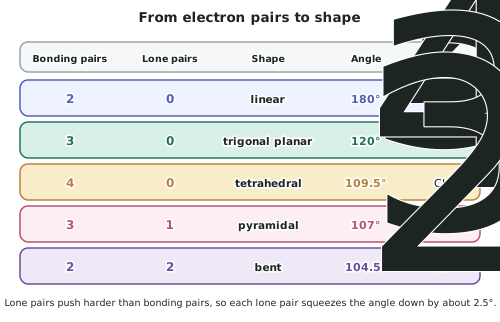
| Bonding pairs | Lone pairs | Shape | Bond angle | Example |
|---|---|---|---|---|
| 2 | 0 | linear | 180° | |
| 3 | 0 | trigonal planar | 120° | |
| 4 | 0 | tetrahedral | 109.5° | |
| 3 | 1 | pyramidal | 107° | |
| 2 | 2 | bent | 104.5° |
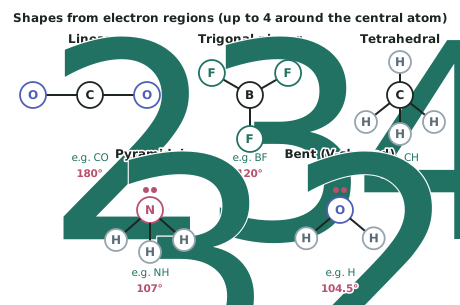
- Notice the last three: 4 pairs in total each time, but the shape and angle change as bonding pairs become lone pairs.
- — 4 bonding, 0 lone → 109.5°
- — 3 bonding, 1 lone → 107° (squeezed once)
- — 2 bonding, 2 lone → 104.5° (squeezed twice)
The method
- Draw the Lewis structure.
- Count the bonding pairs and the lone pairs on the central atom.
- Treat a double or triple bond as ONE region of electrons.
- Look up the shape and angle from the table.
- Name the shape by where the ATOMS are, not where the electron pairs are.
Why a double bond counts as one
- The two pairs of a double bond are both between the same two atoms, so they sit in the same direction.
- For deciding shape, what matters is how many directions the electrons point in.
- has two double bonds — that is two directions, so it is linear at 180°, not bent.
Worked ExamplePredicting shape and bond angle
Predict the shape and bond angle of (a) and (b) (methanal), explaining your reasoning in each case.
(a)
Step 1 — Count the outer electrons. Sulfur is in group 16 → 6. Each hydrogen gives 1 → 2. Total 8, which is 4 pairs.
Step 2 — Work out the arrangement. Two pairs are used bonding to the two hydrogens, so:
- Bonding pairs: 2
- Lone pairs: 2
Step 3 — Read off the shape. Two bonding pairs and two lone pairs → bent.
Step 4 — Give the angle. Four pairs would give 109.5°, but two lone pairs each squeeze it by about 2.5°:
Answer: bent, about 104.5° — the same as water, which makes sense since sulfur is directly below oxygen in group 16.
(b)
Step 1 — Count the outer electrons. C gives 4, each H gives 1 (→2), O gives 6. Total 12, which is 6 pairs.
Step 2 — Build the structure. Carbon is central. It bonds to two hydrogens and, to give everyone a full shell, forms a double bond to the oxygen: .
Step 3 — Count the regions around the carbon. This is the step that decides it:
- Two single bonds to hydrogen → 2 regions
- One double bond to oxygen → counts as 1 region
Step 4 — Read off the shape. Three regions and no lone pairs → trigonal planar, angle 120°.