Specific heat capacity and calorimetry
Specific heat capacity
- The specific heat capacity, , is the energy needed to raise the temperature of 1 g of a substance by 1 °C.
- For water, J g−1 °C−1. This value is given in the question whenever it is needed.
- Water's specific heat capacity is unusually high, because energy supplied must also work against the hydrogen bonding between molecules.
The relationship
-
is the heat energy transferred, in joules
-
is the mass of the substance being heated, in grams
-
is the specific heat capacity, in J g−1 °C−1
-
is the temperature change, in °C — always final minus initial
-
This relationship is supplied in the resource booklet.
-
comes out in joules. Enthalpy changes are quoted in kilojoules, so divide by 1000.
Calorimetry
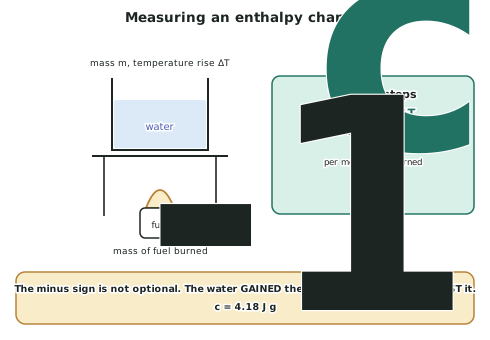
-
A calorimetry experiment measures an enthalpy change by measuring the temperature change of a known mass of water.
-
The method is always the same two steps:
-
Find the heat gained by the water using .
-
Divide by the amount of the substance reacting to get the enthalpy change per mole:
Why the minus sign
- The water gained the energy, so for the water is positive.
- That energy came from the reaction, so the reaction lost it and its enthalpy change is negative.
- The minus sign converts "energy gained by the water" into "enthalpy change of the reaction". It is not optional.
Which mass goes in
-
is the mass of the substance being heated — almost always the water.
-
It is not the mass of fuel burned, and not the mass of the beaker.
-
The mass of fuel is used in the second step, to find .
-
For a reaction in solution, is the mass of the solution, and unless told otherwise you may take the density as 1.00 g mL−1 so that 50.0 mL has a mass of 50.0 g.
Why experimental values are always too small
This comes up almost every year, and the answer is always about heat loss.
-
Heat is lost to the surroundings — to the air, the beaker, the tripod and the apparatus — rather than all going into the water.
-
Incomplete combustion may occur, so less energy is released per gram of fuel than complete combustion would give.
-
Some fuel may evaporate without burning.
-
All of these make the measured temperature rise smaller than it should be, so the calculated is too small and the magnitude of comes out lower than the true value.
-
Note the direction carefully: the experimental value is less negative than the accepted one.
Worked ExampleA calorimetry experiment
A student burns propan-1-ol, , in a spirit burner to heat 150.0 g of water in a beaker. The following data was recorded:
- initial water temperature = 24.6 °C
- final water temperature = 45.2 °C
- initial mass of burner and fuel = 84.375 g
- final mass of burner and fuel = 83.963 g
The specific heat capacity of water is 4.18 J g−1 °C−1 and g mol−1.
(a) Calculate the experimental enthalpy of combustion of propan-1-ol. (b) The accepted value is −2021 kJ mol−1. Account for the difference.
Part (a)
Step 1 — Find the temperature rise of the water.
Step 2 — Find the heat gained by the water. Use with the mass of the water, 150.0 g — not the mass of fuel.
Convert to kilojoules:
Step 3 — Find the amount of fuel burned. The mass burned is the loss in mass of the burner:
Step 4 — Find the enthalpy change per mole. The water gained 12.9162 kJ, so the reaction lost it — hence the minus sign.
Part (b)
Step 1 — Compare the two values. The experimental value, −1880 kJ mol−1, is less negative than the accepted −2021 kJ mol−1. The experiment therefore underestimated the magnitude of the energy released, by about 7 %.
Step 2 — Identify why came out too small. The calculation assumes that all the energy released by the burning fuel went into the water. In practice:
- a large amount of heat is lost to the surroundings — warming the air, the beaker, the tripod and the gauze,
- incomplete combustion may produce some carbon monoxide or soot, releasing less energy per mole than complete combustion,
- some propan-1-ol may evaporate from the wick without burning, so the mass loss overstates the fuel actually combusted.
Step 3 — Trace the effect on the answer. Heat loss and incomplete combustion both make the measured temperature rise smaller than it should be, so the calculated is too small.
Evaporation makes the mass burned appear larger than it was, so the calculated is too large.
, so a smaller or a larger both make the result smaller in magnitude.