Polarity of molecules
Two separate questions
A molecule is polar only if both of these are true. Answering only the first is the classic half-mark answer.
- Does it contain polar bonds?
- Do those bond dipoles fail to cancel?
Polar bonds
-
A polar bond forms when two bonded atoms have different electronegativities.
-
The more electronegative atom pulls the bonding electrons towards itself, so it becomes slightly negative, , and the other atom slightly positive, .
-
The larger the electronegativity difference, the more polar the bond.
-
Two atoms of the same element share equally, so the bond is non-polar.
-
The separation of charge across a bond is called a bond dipole. It has a direction — it points towards the more electronegative atom.
Whether the dipoles cancel
- Bond dipoles are directional, so they add up like arrows: two equal dipoles pointing in opposite directions cancel to nothing.
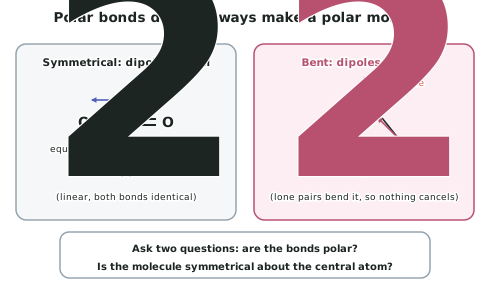
- If the molecule is symmetrical about the central atom, with identical atoms arranged evenly around it, the dipoles cancel and the molecule is non-polar.
- If the arrangement is not symmetrical — because of a lone pair or because the outer atoms are not all the same — the dipoles do not cancel and the molecule is polar.
Working it out
- Draw the Lewis structure and get the shape right first. Polarity cannot be decided without the shape.
- Mark and on each polar bond.
- Ask: are the bond dipoles arranged so that they cancel?
- Identical outer atoms, evenly spaced, no lone pairs on the central atom → cancel → non-polar.
- Otherwise → do not cancel → polar.
The shapes that cancel
These shapes are non-polar provided all the outer atoms are identical:
- linear (), trigonal planar (), tetrahedral ()
- trigonal bipyramidal (), octahedral (), square planar ()
These shapes are polar when the bonds are polar, because a lone pair has destroyed the symmetry:
-
bent (, ), pyramidal ()
-
see-saw (), T-shaped (), square pyramidal ()
-
Note the two exceptions among the lone-pair shapes: linear with three lone pairs () and square planar with two lone pairs () are still non-polar, because in both the lone pairs are arranged symmetrically and the bonds still point in cancelling directions.
Changing one atom breaks the symmetry
- is tetrahedral with four identical C–Cl dipoles that cancel — non-polar.
- is also tetrahedral, but one atom is hydrogen. The C–H dipole is much smaller than the three C–Cl dipoles, so they no longer cancel — polar.
Worked ExampleDeciding between two possible shapes
Bromine trifluoride, , could in principle be trigonal planar or T-shaped; both are based on arrangements of electron pairs around the central bromine. Experiments show that the molecule is polar. Compare the two possible shapes to identify which one must have. Refer to bond polarity and to the arrangement of the bond dipoles.
Step 1 — Establish that the bonds are polar
Fluorine is the most electronegative element, and it is considerably more electronegative than bromine.
Each Br–F bond therefore has the bonding electrons pulled strongly towards the fluorine, giving each fluorine a charge and the bromine a charge.
All three Br–F bonds are polar, and all three dipoles are equal in size — the bonds are identical.
Step 2 — Test the trigonal planar option
In a trigonal planar shape the three fluorines would lie in one plane, evenly spaced at 120° to one another around the bromine.
Three equal dipoles arranged symmetrically at 120° in a plane point outwards in three directions that are balanced against each other. Their effects cancel exactly.
A trigonal planar would therefore be non-polar.
Step 3 — Test the T-shaped option
In a T-shaped molecule the three fluorines are not evenly spaced: two lie roughly opposite one another and the third sits at about 90° to both, with two lone pairs occupying the remaining positions.
The two opposed dipoles cancel each other, but the third has nothing to cancel against.
There is therefore a net dipole pointing along the direction of that third bond, and a T-shaped would be polar.
Step 4 — Match against the evidence
The molecule is observed to be polar. Only one of the two candidate shapes predicts that.