Solubility
Dissolving is a swap, not a disappearance
-
For something to dissolve, attractions must be broken and new ones formed:
- attractions between the solute particles must be broken,
- attractions between the solvent particles must be broken,
- new attractions between solute and solvent must form.
-
A substance dissolves when the new solute–solvent attractions are strong enough to replace the ones that were broken.
-
Every solubility answer is a comparison between those two sets of attractions. If your answer does not compare, it is not yet an explanation.
Like dissolves like
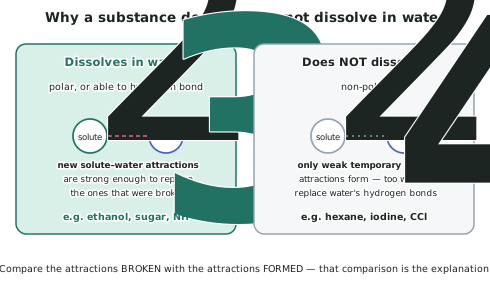
- Polar solutes dissolve in polar solvents. The solute and solvent form permanent dipole attractions, or hydrogen bonds if both can.
- Non-polar solutes dissolve in non-polar solvents. Both have only temporary dipole attractions, and the ones formed replace the ones broken.
- Polar and non-polar do not mix, because the new attractions are too weak to pay for the ones that must be broken.
Why non-polar substances will not dissolve in water
-
Water molecules are held to each other by hydrogen bonding, which is strong.
-
A non-polar solute can form only temporary dipole attractions with water.
-
Those are far too weak to compensate for the hydrogen bonds that would have to be broken to make room for the solute.
-
So the water molecules stay hydrogen bonded to each other, and the solute stays separate.
-
Hexane and iodine are insoluble in water for exactly this reason, and both dissolve readily in each other.
Ionic solids in water
- An ionic solid dissolves when the ion–dipole attractions between the ions and the water molecules are strong enough to replace the ionic attractions in the lattice.
- Water surrounds each ion: the oxygen faces a cation, and the hydrogens face an anion.
- Ionic solids with very strong lattice attractions — high charges, small ions — tend to be insoluble, because the ion–dipole attractions cannot compete.
The chain length effect
- In an alcohol, the –OH group can hydrogen bond with water but the hydrocarbon chain cannot.
- Short-chain alcohols such as methanol and ethanol are completely miscible with water, because the –OH dominates.
- As the chain gets longer, the non-polar part becomes a larger fraction of the molecule and solubility falls. Butan-1-ol is only partly soluble; octan-1-ol is essentially insoluble.
Worked ExampleExplaining two solubilities
Ethanol, , mixes with water in all proportions. Hexane, , does not dissolve in water at all, but ethanol and hexane mix readily. Explain all three observations.
Step 1 — Identify the attractions in each pure substance
- Water: polar, with O–H bonds and lone pairs, so water molecules are held together by hydrogen bonding — strong.
- Ethanol: has an –OH group, so ethanol molecules are also held together by hydrogen bonding.
- Hexane: a hydrocarbon with essentially non-polar C–H bonds, so hexane molecules are held together by temporary dipole attractions only — weak.
Step 2 — Ethanol and water
To mix them, hydrogen bonds between water molecules and hydrogen bonds between ethanol molecules must both be broken.
Ethanol's –OH group provides a strongly hydrogen and an oxygen with lone pairs, so ethanol can act as both donor and acceptor — exactly as water can.
New hydrogen bonds form between ethanol and water molecules. These are of comparable strength to the ones broken, so the swap costs essentially nothing.
Ethanol and water are completely miscible.
Step 3 — Hexane and water
To dissolve hexane, the strong hydrogen bonds between water molecules would have to be broken to make room for it.
Hexane is non-polar: it has no hydrogen to donate and no lone pair on N, O or F to accept with. The only attraction it can form with water is a temporary dipole attraction.
Those are far weaker than the hydrogen bonds that would be broken, so there is nothing to pay for breaking them.
The water molecules remain hydrogen bonded to each other and exclude the hexane. Hexane is insoluble in water.
Step 4 — Ethanol and hexane
Here the attractions that must be broken are hexane's temporary dipole attractions, which are weak, and ethanol's hydrogen bonds.
Ethanol's molecule is largely a hydrocarbon chain, , which forms temporary dipole attractions with hexane perfectly well. Those readily replace the weak attractions broken in the hexane.
Ethanol and hexane mix.