Phase changes
The three enthalpy changes of state
-
— fusion: 1 mol solid → liquid (melting)
-
— vaporisation: 1 mol liquid → gas (boiling)
-
— sublimation: 1 mol solid → gas directly
-
All three are positive, because energy must be supplied to separate the particles against the attractions holding them together.
-
Reverse any of them — freezing, condensing, depositing — and the sign becomes negative.
Sublimation is the sum of the other two
- Enthalpy changes depend only on the start and end points, not the route taken. So going solid → gas directly must cost the same as going solid → liquid → gas.
- This is Hess's law applied to a change of state, and it is a common short exam question.
Why vaporisation costs far more than fusion
- Melting only lets the particles move past one another. They stay close together, so most of the attractions between them remain.
- Boiling completely separates the particles, so all the attractions between them must be overcome.
- For water, kJ mol−1 but kJ mol−1 — nearly seven times as much.
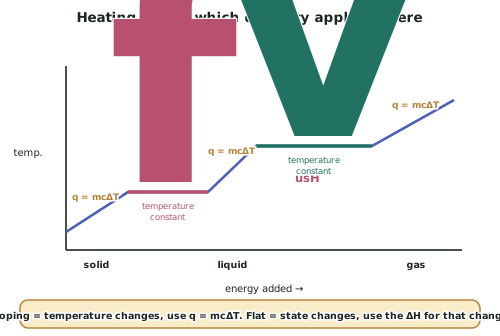
The heating curve
-
Sloping sections — the temperature is rising, the substance is in one state, and the energy goes into making the particles move faster. Use .
-
Flat sections — the temperature does not change even though energy is still being supplied. Use the relevant of state change.
-
On a flat section the supplied energy is separating the particles, not speeding them up. The average kinetic energy is unchanged, so the thermometer does not move.
-
The flat section at the boiling point is much longer than the one at the melting point, because is so much larger.
Multi-stage calculations
- When a question spans a phase change, break it into separate stages and add them.
- For each stage decide which relationship applies:
- temperature changing →
- state changing → for that change
- Watch the units. works in grams and joules; the values are in kJ per mole. Convert everything to kJ before adding.
Worked ExampleHeating and boiling water
Calculate the total energy needed to convert 50.0 g of liquid water at 18.0 °C into steam at 100 °C.
J g−1 °C−1, kJ mol−1, g mol−1
Step 1 — Identify the stages
There are two distinct stages, and they need different relationships:
- Stage 1: heating the liquid water from 18.0 °C up to 100 °C. The temperature changes, so use .
- Stage 2: boiling all of it at 100 °C. The temperature stays constant, so use .
Step 2 — Stage 1, heating the liquid
Convert to kilojoules straight away, so both stages are in the same unit:
Step 3 — Stage 2, boiling the liquid
is quoted per mole, so first find the amount of water.
Step 4 — Add the stages