Electron configurations
What an electron configuration tells you
- An electron configuration states which sublevels an atom's electrons occupy and how many are in each.
- It is written using s, p, d notation — for example sodium is .
- At Level 3 you need the configurations of the atoms and ions of the first 36 elements, hydrogen to krypton.
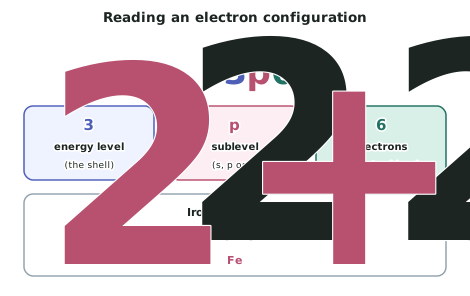
Reading the notation
Each block of the configuration has three parts:
-
The number is the energy level (the shell) — 1, 2, 3 or 4.
-
The letter is the sublevel — s, p or d.
-
The superscript is the number of electrons in that sublevel.
-
So means six electrons in the p sublevel of the third energy level.
How many electrons fit
-
An s sublevel holds a maximum of 2 electrons.
-
A p sublevel holds a maximum of 6 electrons.
-
A d sublevel holds a maximum of 10 electrons.
-
The first energy level has an s sublevel only. The second has s and p. The third has s, p and d. That is why the numbers run 2, 8, 18.
The filling order
- Electrons fill the lowest available energy sublevel first.
- The order by energy is:
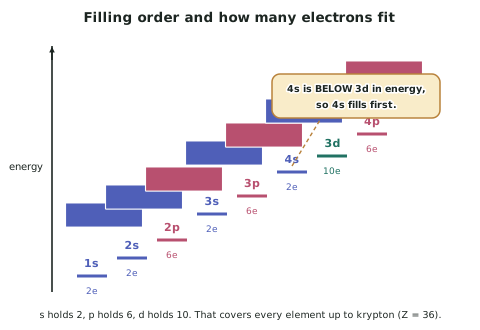
- Note the 4s and 3d swap. The 4s sublevel is lower in energy than 3d, so 4s fills first even though it belongs to a higher shell.
- That single fact is what makes the transition metals work, and it is the most common place to drop a mark.
Writing a configuration
To write the configuration of an atom:
-
Find the atomic number — that is the number of electrons in the neutral atom.
-
Fill the sublevels in the order above until you have used them all up.
-
Check by adding the superscripts: they must total the atomic number.
-
Worked through for a few elements:
- Neon (Z = 10):
- Phosphorus (Z = 15):
- Calcium (Z = 20):
- Iron (Z = 26):
- Krypton (Z = 36):
Configurations of ions
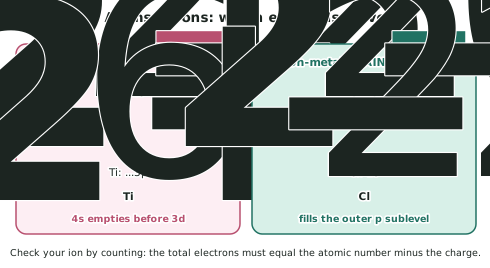
- A positive ion (cation) is formed by losing electrons; a negative ion (anion) by gaining them.
-
Metals lose electrons from the outermost shell first.
- For a transition metal this means the 4s electrons leave before any 3d electrons, even though 4s filled first.
- :
- : — the two 4s electrons are gone.
- : — both 4s electrons plus one 3d.
-
Non-metals gain electrons into the highest partly filled sublevel.
- : , so : .
-
Check every ion by counting. The total number of electrons must equal the atomic number minus the charge.
Worked ExampleConfigurations of an atom and its ions
Write the full electron configurations of a bromine atom (Z = 35), the bromide ion, an iron atom (Z = 26), and the iron(III) ion.
Step 1 — Bromine atom
Bromine has 35 electrons, so we fill the sublevels in energy order until 35 are used.
(2) → (4) → (10) → (12) → (18) → (20) → (30) → (35).
Check: 2 + 2 + 6 + 2 + 6 + 2 + 10 + 5 = 35 ✓
Step 2 — The bromide ion
Bromine is a non-metal, so it gains one electron to form . The electron goes into the highest partly filled sublevel, which is 4p.
Check: 35 + 1 = 36 electrons ✓ — the same as krypton.
Step 3 — Iron atom
Iron has 26 electrons. Remember that 4s fills before 3d.
(2) → (4) → (10) → (12) → (18) → (20) → (26).
Step 4 — The iron(III) ion
has lost three electrons. Iron is a metal, so the electrons leave from the outermost shell first — that is the 4s sublevel, not 3d.
Remove both 4s electrons first (that is two of the three), then remove one 3d electron.
Check: 26 − 3 = 23 electrons, and 2 + 2 + 6 + 2 + 6 + 5 = 23 ✓