Melting and boiling points
What sets a boiling point
-
To boil a molecular substance you must supply enough energy to overcome the attractions between the molecules so they can separate.
-
Stronger attractions between molecules → more energy needed → higher boiling point.
-
The covalent bonds inside each molecule are not broken. Boiling separates whole molecules; it does not take them apart.
-
Melting works the same way, except that the particles only need enough energy to move past one another, not to separate completely. That is why melting points are lower than boiling points.
The three factors, in the order you should check them
-
Is there hydrogen bonding? If one substance has it and the other does not, that usually decides the comparison on its own.
-
Are the molecules polar? A polar molecule has permanent dipole attractions as well.
-
How big are the molecules? More electrons means stronger temporary dipole attractions.
-
When two of these pull in opposite directions, say so, and then say which one wins. That is the Excellence move.
Size and temporary dipole attractions
- Within a series of similar molecules, boiling point rises steadily with molecular size, because the number of electrons rises and the temporary dipole attractions strengthen.
- This is why boiling point increases down group 18, and along the alkanes from methane to octane.
Where hydrogen bonding breaks the pattern
-
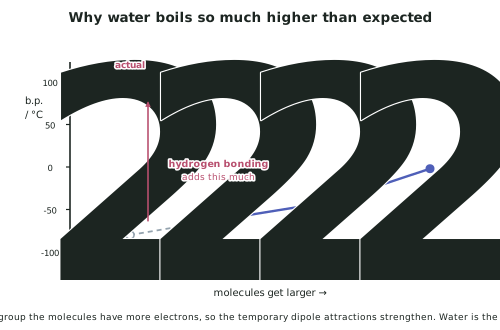
Going down group 16, , and boil at −60 °C, −41 °C and −2 °C: a steady rise as the molecules get larger.
-
Extending that trend backwards predicts water should boil around −80 °C. It boils at +100 °C.
-
The difference is hydrogen bonding. Water is the smallest of the four and so has the weakest temporary dipole attractions, yet it boils highest, because hydrogen bonding is far stronger than the factor working against it.
-
The same anomaly appears for in group 15 and in group 17, for the same reason.
Ionic and network solids
-
Ionic compounds have very high melting and boiling points, because melting requires breaking the strong electrostatic attractions between oppositely charged ions throughout the lattice.
-
The attraction is stronger when the ions carry higher charges and when the ions are smaller, so melts far higher than .
-
A covalent network solid such as diamond or silicon dioxide melts higher still, because melting means breaking covalent bonds themselves.
-
Compare like with like. Do not put an ionic compound and a molecular one side by side and conclude anything about intermolecular forces — the comparison is between different kinds of attraction entirely.
Worked ExampleRanking three molecules of similar size
Butane (, g mol−1), propanal (, g mol−1) and propan-1-ol (, g mol−1) boil at −0.5 °C, 49 °C and 97 °C. Match each compound to its boiling point and explain the order.
Step 1 — Eliminate size as a factor
All three have molar masses between 58 and 60 g mol−1, so they contain a very similar number of electrons.
Their temporary dipole attractions are therefore of similar strength, and cannot explain a 97 °C spread. The difference must come from the other two forces.
Step 2 — Butane
Butane is a hydrocarbon. Carbon and hydrogen have almost the same electronegativity, so the bonds are essentially non-polar, and the molecule is non-polar.
Butane molecules are held together by temporary dipole attractions only — the weakest of the three possibilities.
Least energy needed to separate the molecules → lowest boiling point, −0.5 °C.
Step 3 — Propanal
Propanal contains a group. Oxygen is much more electronegative than carbon, so that bond is strongly polar and the molecule is polar.
Propanal molecules therefore have permanent dipole attractions as well as temporary dipole attractions.
But every hydrogen in propanal is bonded to carbon, so there is no O–H bond and no hydrogen bonding between propanal molecules.
More energy needed than for butane, less than for a hydrogen-bonded liquid → middle boiling point, 49 °C.
Step 4 — Propan-1-ol
Propan-1-ol has an –OH group, so its hydrogen is bonded directly to oxygen, making that hydrogen strongly . The oxygen of a neighbouring molecule carries lone pairs.
Both conditions are met, so propan-1-ol molecules are held together by hydrogen bonding, in addition to permanent and temporary dipole attractions.
Hydrogen bonding is much stronger than the other two, so the most energy is needed to separate the molecules → highest boiling point, 97 °C.