Hess's law
The law
Hess's law: the enthalpy change for a reaction is the same whatever route is taken from reactants to products, provided the starting and finishing conditions are the same.
-
Enthalpy is a property of the states, not of the journey between them.
-
So an enthalpy change that cannot be measured directly can be found by an indirect route built from changes that can.
-
This matters because many important reactions cannot be measured in a calorimeter. You cannot make carbon and hydrogen combine cleanly to give methane, but you can burn all three substances, and Hess's law does the rest.
The formation route
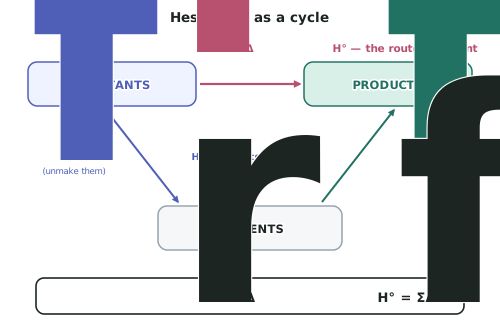
- The most common form in the exam uses formation enthalpies, and the expression is supplied in the resource booklet:
- The cycle behind it goes down from the reactants to the constituent elements, then back up to the products:
- going down un-makes the reactants, which is the reverse of their formation, hence the minus
- going up makes the products, hence the plus
- The elements are the common meeting point of both routes, which is why of an element in its standard state is defined as zero.
Using the formula
-
Multiply each by the coefficient of that substance in the balanced equation.
-
Add the products, add the reactants, then subtract reactants from products.
-
Set to zero the of any element in its standard state.
-
Getting the coefficients in is essential. A missing factor of 2 or 3 is the most common arithmetic slip on this question.
Combining equations directly
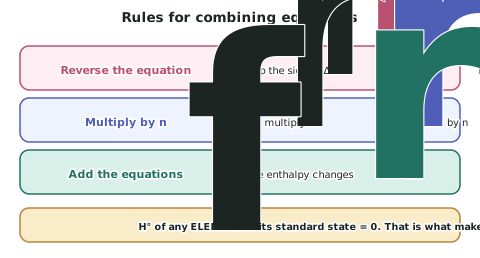
Some questions give you several equations with their enthalpy changes and ask you to build the target. Three rules cover everything:
-
Reverse an equation → flip the sign of its .
-
Multiply an equation by → multiply its by .
-
Add the equations → add the enthalpy changes.
-
Work by looking at where each substance needs to end up:
- Find a substance that appears in only one of the given equations.
- Decide whether it needs to be on the left or the right of the target, and reverse that equation if necessary.
- Scale it so the amount matches the target.
- Repeat, then check that everything not in the target cancels.
Worked ExampleTwo Hess's law routes
(a) Calculate for the complete combustion of ethanol: given : , , kJ mol−1.
(b) Use the data below to calculate for methane:
| Equation | / kJ mol−1 | |
|---|---|---|
| (1) | −393.5 | |
| (2) | −285.8 | |
| (3) | −890.3 |
Part (a) — the formation route
Step 1 — Note the element. Oxygen appears as , which is an element in its standard state, so
Step 2 — Sum the products, using the coefficients. There are 2 mol of and 3 mol of :
Step 3 — Sum the reactants. There is 1 mol of ethanol and 3 mol of oxygen, and the oxygen contributes nothing:
Step 4 — Subtract, products first.
Part (b) — combining equations
Step 1 — Look at where each substance must end up. The target is .
- C(s) must be on the left. In equation (1) it is already on the left → use (1) as written.
- H2(g) must be on the left, and we need 2 mol. In equation (2) it is on the left but there is only 1 mol → multiply (2) by 2.
- CH4(g) must be on the right. In equation (3) it is on the left → reverse (3), which flips the sign.
Step 2 — Write out the manipulated equations.
Equation (1), unchanged:
Equation (2) × 2 — double the enthalpy change too:
Equation (3) reversed — flip the sign:
Step 3 — Add them and check the cancellation. On the left we have , , , , , . On the right we have , , , .
Cancelling what appears on both sides: cancels, cancels, and cancels against the two single on the left.
Step 4 — Add the enthalpy changes.