Entropy and spontaneity
Entropy
-
Entropy, , is a measure of how spread out the energy and the particles of a system are.
-
A system with its particles and energy more spread out and more disordered has a higher entropy.
-
is positive when entropy increases and negative when it decreases.
-
You are never asked to calculate an entropy value at Level 3 — only to work out the sign and use it.
When entropy increases
-
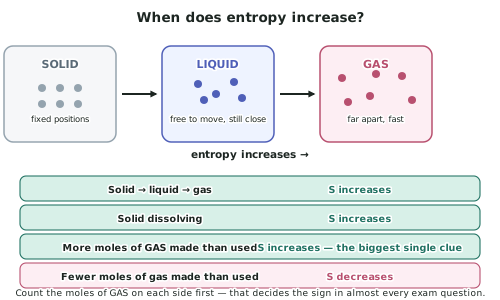
Solid → liquid → gas. Each step gives the particles more freedom, so entropy increases.
-
A solid dissolving. The ordered lattice breaks up into ions or molecules moving freely through the solution, so entropy increases.
-
More moles of gas produced than consumed. Entropy increases.
-
Fewer moles of gas produced than consumed. Entropy decreases.
-
Count the moles of gas on each side first. Gases have far higher entropy than liquids or solids, so a change in the number of moles of gas swamps everything else and decides the sign in almost every exam question.
-
For : 0 mol of gas becomes 1 mol of gas, so is positive.
-
For : 4 mol of gas becomes 2 mol, so is negative.
Two entropy changes, not one
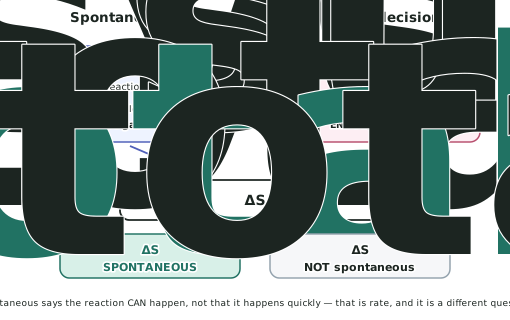
This is where most marks are won and lost. There are two systems to think about.
-
— the entropy change of the reaction itself.
- Found by counting moles of gas and looking at states.
-
— the entropy change of everything else.
- An exothermic reaction releases energy into the surroundings, spreading energy out there, so is positive.
- An endothermic reaction absorbs energy from the surroundings, so is negative.
-
Note the link: the sign of is fixed entirely by the sign of , and it is the opposite sign.
Spontaneity
-
A reaction is spontaneous when is positive.
-
A reaction is not spontaneous when is negative.
-
The four cases:
| (from ) | Spontaneous? | |
|---|---|---|
| + | + (exothermic) | Always |
| − | − (endothermic) | Never |
| + | − (endothermic) | Only if is larger |
| − | + (exothermic) | Only if is larger |
- The bottom two rows are where the interesting questions live. Say which term wins and why.
Temperature
-
The same amount of energy released into the surroundings makes a bigger difference when the surroundings are cold than when they are hot — spreading energy out matters more where there is less of it already.
-
So raising the temperature makes smaller in magnitude, which weakens whichever way the enthalpy term was pushing.
-
Consequently:
- A reaction with positive but endothermic becomes spontaneous at high temperature, because the unfavourable shrinks and takes over.
- A reaction with negative but exothermic becomes non-spontaneous at high temperature, because the favourable shrinks away.
-
This is a qualitative argument only. No calculation is required or expected.
Spontaneous does not mean fast
- Spontaneous means the reaction can happen without a continuous supply of energy. It says nothing about how quickly.
- A mixture of petrol and air is thermodynamically spontaneous and completely stable at room temperature, because its activation energy is high.
- Spontaneity is thermodynamics; speed is kinetics. They are separate questions with separate answers.
Worked ExampleExplaining a spontaneous endothermic change
Instant cold packs work by dissolving solid ammonium nitrate in water inside a sealed bag. The process absorbs energy from its surroundings and the pack becomes cold, yet the ammonium nitrate dissolves readily and completely.
Justify, in terms of the entropy changes of the system and the surroundings, why this process is spontaneous.
Step 1 — Find the sign of
Look at what happens to the particles of the system.
Before: the ammonium nitrate is a solid, in which the and ions are held in fixed positions in a highly ordered ionic lattice.
After: those ions are free to move independently throughout the solution, surrounded by water molecules.
The particles and their energy are now far more spread out than they were in the lattice, and one ordered solid particle has become two mobile ions.
Step 2 — Find the sign of
kJ mol−1, so the process is endothermic: it absorbs energy from the surroundings.
Energy is therefore being removed from the surroundings and concentrated into the system, so the energy in the surroundings becomes less spread out.
This is also exactly why the pack feels cold — it is taking energy out of whatever it touches.
Step 3 — Combine the two
The two terms oppose each other:
So the process is spontaneous only if the positive system term is larger in magnitude than the negative surroundings term.
Step 4 — Decide which term wins, using the evidence
We are told the ammonium nitrate does dissolve, readily and completely. Since dissolving is observed to happen without any energy being supplied, the process must be spontaneous, so must be positive.
Therefore outweighs .
This is chemically reasonable: the enthalpy absorbed is relatively small at only +25.7 kJ mol−1, so the disorder cost to the surroundings is modest, while the increase in disorder on breaking up an ordered lattice into two freely moving hydrated ions is large.