Lewis structures and shapes
What you are asked to do
- Draw a Lewis structure showing every bonding pair and every lone pair.
- State the shape of the molecule or polyatomic ion, and sometimes the bond angle.
- The standard covers up to six electron pairs around the central atom, including species with multiple bonds and polyatomic ions.
Building a Lewis structure
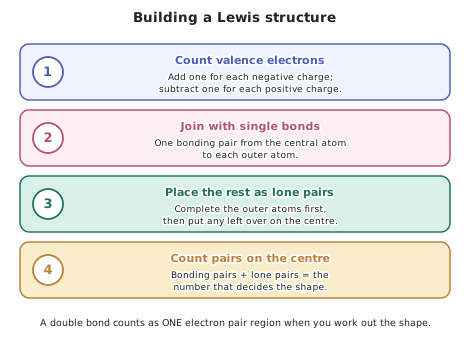
-
Count the total valence electrons.
- Add the group number of valence electrons for every atom.
- Add one electron for each negative charge; subtract one for each positive charge.
- Divide by two to get the number of electron pairs.
-
Join the central atom to each outer atom with a single bond — one pair each.
-
Place the remaining pairs as lone pairs, completing the outer atoms first, then any left over go on the central atom.
-
Count the pairs around the central atom. That total decides the shape.
-
If the outer atoms cannot all be completed, form a double bond by moving a lone pair from an outer atom into the bond.
Arrangement versus shape
This is the distinction that separates Achieved from Merit here.
- The total number of electron pairs decides the arrangement of the pairs in space.
- Only the bonding pairs are described by the shape — lone pairs are present but not named.
- So four pairs always arrange tetrahedrally, but the shape is tetrahedral, pyramidal or bent depending on how many are lone pairs.
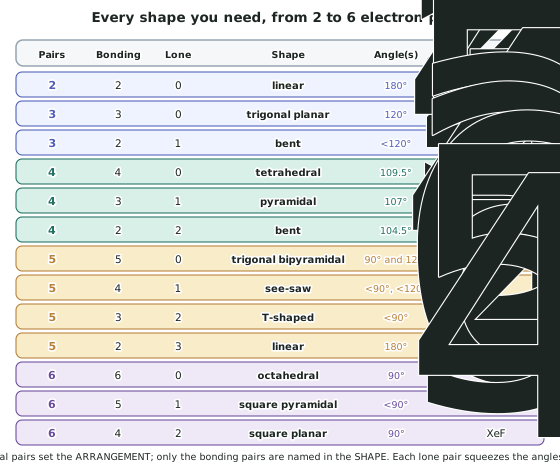
The full set of shapes
| Pairs | Bonding | Lone | Shape | Angle(s) |
|---|---|---|---|---|
| 2 | 2 | 0 | linear | 180° |
| 3 | 3 | 0 | trigonal planar | 120° |
| 3 | 2 | 1 | bent | <120° |
| 4 | 4 | 0 | tetrahedral | 109.5° |
| 4 | 3 | 1 | pyramidal | 107° |
| 4 | 2 | 2 | bent | 104.5° |
| 5 | 5 | 0 | trigonal bipyramidal | 90° and 120° |
| 5 | 4 | 1 | see-saw | <90°, <120° |
| 5 | 3 | 2 | T-shaped | <90° |
| 5 | 2 | 3 | linear | 180° |
| 6 | 6 | 0 | octahedral | 90° |
| 6 | 5 | 1 | square pyramidal | <90° |
| 6 | 4 | 2 | square planar | 90° |
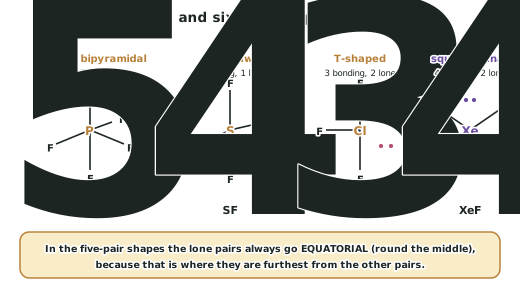
Where the lone pairs go
- Electron pairs arrange themselves as far apart as possible, because pairs of electrons repel each other.
- Lone pairs repel more strongly than bonding pairs, because a lone pair is held by only one nucleus and so spreads out closer to the central atom.
- Consequently:
- Each lone pair squeezes the bond angles in by roughly 2.5°.
- In the five-pair shapes the lone pairs always take the equatorial positions, where they are furthest from the other pairs.
- In the six-pair shapes with two lone pairs, the lone pairs go opposite each other, giving square planar.
Multiple bonds
- A double or triple bond counts as ONE region when you work out the shape.
- has two double bonds and no lone pairs on carbon, so it is two regions — linear, 180°.
- has two double bonds and one lone pair on sulfur, so it is three regions — bent, a little under 120°.
Worked ExampleTwo structures from an electron count
Draw the Lewis structures of sulfur tetrafluoride, , and the tetrachloroiodate ion, . Give the shape of each.
Part (a) —
Step 1 — Count the valence electrons. Sulfur is in group 16, so it contributes 6. Each fluorine is in group 17, contributing 7, and there are four of them.
There is no charge, so no adjustment is needed.
Step 2 — Make the bonds. Join sulfur to each fluorine with a single bond. That uses 4 pairs, leaving 13.
Step 3 — Complete the outer atoms. Each fluorine needs three lone pairs to complete its octet. Four fluorines use pairs, leaving 1 pair.
Step 4 — Place what is left, and count. The remaining 1 pair goes on the sulfur as a lone pair.
Around the sulfur there are now 4 bonding pairs + 1 lone pair = 5 electron pairs.
Five pairs arrange trigonal bipyramidally, and the lone pair takes an equatorial position.
Part (b) —
Step 1 — Count the valence electrons, including the charge. Iodine is in group 17, contributing 7. Each of the four chlorines contributes 7. The ion carries a 1− charge, so add one electron.
Step 2 — Make the bonds. Join iodine to each chlorine with a single bond: 4 pairs used, 14 remain.
Step 3 — Complete the outer atoms. Three lone pairs on each chlorine uses pairs, leaving 2 pairs.
Step 4 — Place what is left, and count. Both remaining pairs go on the iodine.
Around the iodine there are 4 bonding pairs + 2 lone pairs = 6 electron pairs.
Six pairs arrange octahedrally, and two lone pairs sit opposite each other, leaving the four bonds in one plane.