Attractive forces between particles
The forces you need
The standard lists the attractive forces between atoms, ions and molecules that you must be able to identify and use:
-
Ionic bonds — the electrostatic attraction between oppositely charged ions in a lattice.
-
Covalent bonds — a shared pair of electrons attracted to the nuclei of both bonded atoms.
-
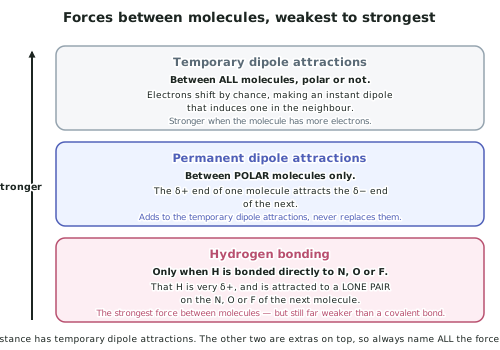
Intermolecular attractions, which come in three kinds:
- temporary dipole attractions
- permanent dipole attractions
- hydrogen bonding
-
Ionic and covalent bonds are strong. All three intermolecular attractions are much weaker than either.
Temporary dipole attractions
-
Electrons in a molecule are constantly moving, so at any instant they may be unevenly distributed, creating a temporary dipole.
-
That temporary dipole induces a dipole in a neighbouring molecule, and the two attract.
-
Every molecule has these attractions, polar or not — they are never absent.
-
They get stronger as the molecule gets larger, because a molecule with more electrons has a more polarisable electron cloud and forms larger temporary dipoles.
-
This is why boiling point rises steadily down a homologous series, and down group 18 from helium to radon.
Permanent dipole attractions
- A polar molecule has a permanent dipole — a end and a end that are always there.
- The end of one molecule is attracted to the end of the next.
- These are stronger than temporary dipole attractions between molecules of similar size.
- They are an addition to the temporary dipole attractions, not a replacement — a polar molecule has both.
Hydrogen bonding
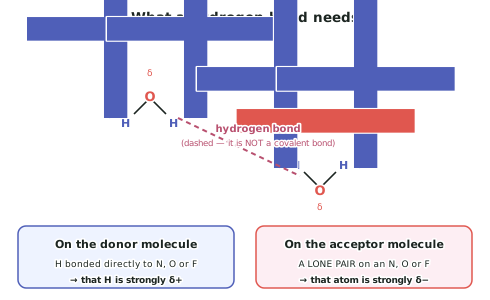
- A hydrogen bond is the strongest of the three, and it needs two things to be present.
-
On one molecule: a hydrogen atom bonded directly to N, O or F.
- Those three are the most electronegative elements, and hydrogen is very small, so that hydrogen is left strongly with its nucleus almost exposed.
-
On the other molecule: a lone pair on an N, O or F atom.
- That atom is strongly and its lone pair is what the hydrogen is attracted to.
-
Both conditions must hold. A molecule with an O but no O–H, such as propanone, cannot donate a hydrogen bond to another propanone molecule — although it can accept one from water.
-
A hydrogen bond is still an intermolecular attraction, not a covalent bond. It is roughly a tenth the strength of a covalent bond.
Naming all the forces present
- This is a common exam instruction: "identify all the types of attractive forces".
- Work up the list and include everything that applies:
| Substance | Temporary dipole | Permanent dipole | Hydrogen bonding |
|---|---|---|---|
| (non-polar) | ✓ | ✗ | ✗ |
| (polar, no O–H) | ✓ | ✓ | ✗ |
| (polar, N–H) | ✓ | ✓ | ✓ |
- Every substance in the table has temporary dipole attractions. Leaving them out costs a mark.
Worked ExampleIdentifying and comparing forces
Identify all the types of attractive force between the molecules of ammonia, , and of phosphine, , in their liquid states. Ammonia boils at −33 °C and phosphine at −88 °C. Explain the difference in boiling points.
Step 1 — Establish the shape and polarity of each
Both molecules have a central atom from group 15 with three bonding pairs and one lone pair: four electron pairs, so both are pyramidal.
Because both are pyramidal, neither is symmetrical, so if the bonds are polar the molecules will be polar.
- N–H: nitrogen is much more electronegative than hydrogen, so the bonds are strongly polar and ammonia is a polar molecule.
- P–H: phosphorus and hydrogen have very similar electronegativities, so the P–H bonds are only very slightly polar. Phosphine is at most weakly polar.
Step 2 — Identify the forces in phosphine
Phosphine molecules have:
- Temporary dipole attractions — present in every substance.
- At most very weak permanent dipole attractions, because the P–H bonds are barely polar.
There is no hydrogen bonding, because hydrogen is bonded to phosphorus, which is not N, O or F.
Step 3 — Identify the forces in ammonia
Ammonia molecules have:
- Temporary dipole attractions — again, always present.
- Permanent dipole attractions, because the molecule is polar.
- Hydrogen bonding, because hydrogen is bonded directly to nitrogen (making it strongly ) and each nitrogen carries a lone pair for that hydrogen to be attracted to.
Step 4 — Explain the boiling points
Boiling requires enough energy to overcome the attractions between the molecules, so the substance with the stronger intermolecular attractions boils higher.
Working against ammonia, phosphine is the larger molecule with more electrons, so its temporary dipole attractions are actually stronger than ammonia's. On that factor alone phosphine would be expected to boil higher.
But ammonia has hydrogen bonding, which is much stronger than either of the other two attractions, and phosphine has none at all.
The hydrogen bonding more than compensates for ammonia's weaker temporary dipole attractions, so considerably more energy is needed to separate ammonia molecules.