Enthalpy changes and thermochemical equations
What an enthalpy change is
-
The enthalpy change, , is the heat energy transferred during a change carried out at constant pressure.
-
Exothermic changes release energy to the surroundings, so is negative.
-
Endothermic changes absorb energy from the surroundings, so is positive.
-
The sign is part of the answer. An enthalpy change written without its sign is wrong, not incomplete.
The symbols
The standard lists six enthalpy changes by name, and each has a precise definition.
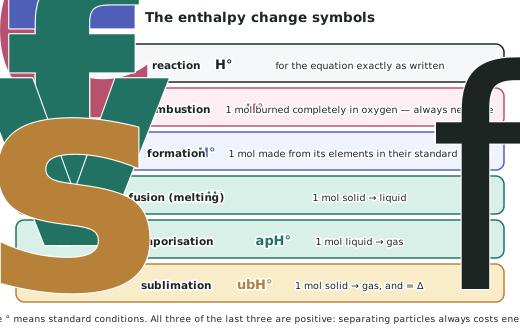
| Symbol | Name | Definition | Sign |
|---|---|---|---|
| reaction | for the equation exactly as written | either | |
| combustion | 1 mol of a substance burned completely in oxygen | always negative | |
| formation | 1 mol made from its elements in their standard states | either | |
| fusion | 1 mol solid → liquid | always positive | |
| vaporisation | 1 mol liquid → gas | always positive | |
| sublimation | 1 mol solid → gas directly | always positive |
- The ° symbol means standard conditions.
- Notice the phrase "1 mol" in five of the six definitions. Only refers to the equation as written.
Two definitions worth learning word for word
- is the enthalpy change when one mole of a substance is completely burned in oxygen under standard conditions.
- "Completely" matters: carbon must go to , not .
- is the enthalpy change when one mole of a substance is formed from its elements in their standard states under standard conditions.
- Standard state means the form the element takes at 25 °C and 100 kPa — , , .
- It follows that of any element in its standard state is zero. There is no change involved in making an element from itself.
Thermochemical equations
- A thermochemical equation is a balanced equation with its enthalpy change written beside it:
- State symbols are compulsory. The same reaction producing steam instead of liquid water has a different enthalpy change, because vaporising the water costs energy.
- The quoted value applies to the molar amounts in that equation — here, 2 mol of hydrogen, not 1.
Scaling with amount
-
Energy transferred = (amount reacting ÷ amount in the equation) × .
-
Double the amount, double the energy. Halve it, halve the energy. The sign never changes.
-
Reverse the equation and the sign flips: forming water releases 572 kJ, so splitting it back up absorbs 572 kJ.
-
The two quantity relationships you will need are supplied in the resource booklet:
Worked ExampleScaling a thermochemical equation
The complete combustion of hydrogen is described by (a) Calculate the energy released when 3.60 g of hydrogen is burned completely. (b) Write the thermochemical equation that defines for liquid water, and state its value. g mol−1
Part (a)
Step 1 — Find the amount of hydrogen. Use .
Step 2 — Compare with the equation. The equation's enthalpy change of −572 kJ applies to 2 mol of , not 1 mol. So find what fraction of the equation we actually have:
Step 3 — Scale the enthalpy change.
Step 4 — Answer the question that was asked. The question asked for the energy released, so quote the magnitude and say it is released.
Part (b)
Step 1 — Apply the definition. is for one mole of the substance formed from its elements in their standard states. The elements here are hydrogen gas and oxygen gas, both diatomic.
Step 2 — Write the equation with 1 mol of product. The product must be 1 mol of , so the oxygen coefficient becomes a fraction.
Step 3 — Halve the enthalpy change. The equation we were given makes 2 mol of water and releases 572 kJ. Ours makes 1 mol, so it releases half as much.