Periodic trends and ionic radii
The three quantities
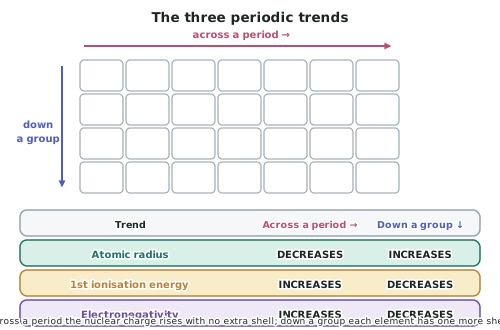
You need three trends, and one set of reasons explains all three.
- Atomic radius — the size of the atom.
- First ionisation energy — the energy needed to remove one mole of electrons from one mole of gaseous atoms:
- Electronegativity — how strongly an atom attracts the bonding electrons in a covalent bond towards itself.
The two reasons behind every trend
Every explanation in this section is built from just two ideas. Learn these and you never have to memorise a trend again.
-
Across a period, the nuclear charge increases but each added electron goes into the same shell, so the shielding stays about the same.
- The outer electrons are therefore attracted more strongly and pulled closer to the nucleus.
-
Down a group, each element has one more occupied shell.
- The outer electrons are further from the nucleus and are shielded from it by more inner electrons, so they are attracted less strongly.
Atomic radius
- Across a period, atomic radius decreases.
- The greater nuclear charge pulls the same shell in tighter.
- Down a group, atomic radius increases.
- There is an extra shell, and the added shielding outweighs the extra nuclear charge.
First ionisation energy
- Across a period, first ionisation energy increases.
- The outer electron is closer to the nucleus and feels a greater nuclear charge, so more energy is needed to remove it.
- Down a group, first ionisation energy decreases.
- The outer electron is further out and more shielded, so it is held less tightly and needs less energy to remove.
Electronegativity
-
Across a period, electronegativity increases. Same reason: a smaller atom with a greater nuclear charge pulls bonding electrons harder.
-
Down a group, electronegativity decreases. Same reason: the bonding electrons are further out and more shielded.
-
Fluorine is the most electronegative element. The noble gases are normally left out of the trend because they do not usually form bonds.
Comparing an atom with its ion
- A cation is always smaller than the atom it came from.
- Losing the outer electrons often removes a whole shell.
- The remaining electrons are held by the same nuclear charge but there are fewer of them, so there is less repulsion between them and they are pulled closer in.
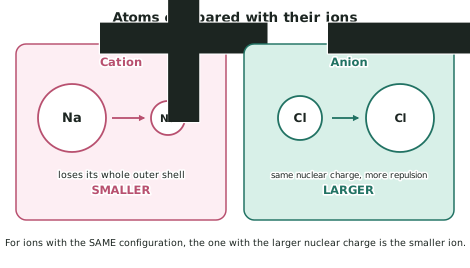
- An anion is always larger than the atom it came from.
- The nuclear charge is unchanged but there are now more electrons.
- The extra repulsion between the electrons pushes the electron cloud out, so the ion is bigger.
Ions with the same configuration
- Ions with the same electron configuration are called isoelectronic.
- Among these, the ion with the larger nuclear charge is the smaller ion, because the same number of electrons is pulled in harder.
- For example , , , , all have ten electrons, and their radii decrease in that order as the nuclear charge rises from 7 to 12.
Worked ExampleOrdering and justifying a trend
Arrange sulfur (S), chlorine (Cl) and selenium (Se) in order of decreasing first ionisation energy. Use your knowledge of periodic trends to justify your order.
Step 1 — Locate the three elements
Write the configurations so the positions are obvious:
- (Z = 16): — period 3, group 16
- (Z = 17): — period 3, group 17
- (Z = 34): — period 4, group 16
So S and Cl are in the same period, and S and Se are in the same group.
Step 2 — Compare S and Cl (same period)
Both have their outer electrons in the third shell, so the shielding is about the same.
Chlorine has one more proton than sulfur, so it has a greater nuclear charge. Its outer electrons are therefore held more strongly and the atom is smaller.
More energy is needed to remove an electron from chlorine.
Step 3 — Compare S and Se (same group)
Selenium's outer electrons are in the fourth shell, sulfur's in the third.
Selenium's outer electrons are therefore further from the nucleus and are shielded by more inner electrons, so they are attracted less strongly despite selenium's greater nuclear charge.
Less energy is needed to remove an electron from selenium.
Step 4 — Combine
Putting the two comparisons together: