Titration curves
What a titration curve shows
- A titration curve plots the pH of the solution in the flask against the volume of titrant added.
- Its shape tells you the strengths of the acid and base involved, and where the equivalence point lies.
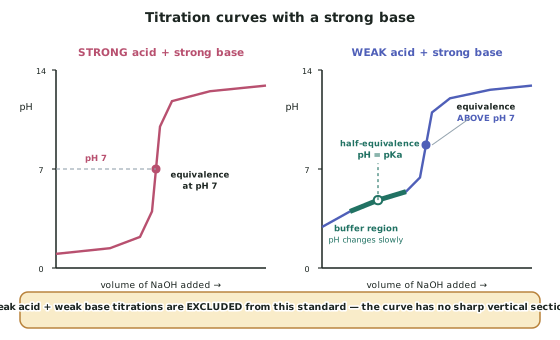
The equivalence point
- The equivalence point is where the acid and base have been mixed in exactly the stoichiometric ratio — all the acid has been neutralised, with no excess of either.
- Its pH is not always 7. It depends on what salt has been formed:
| Titration | Salt formed | pH at equivalence |
|---|---|---|
| strong acid + strong base | neutral salt | 7 |
| weak acid + strong base | salt of a weak acid → basic | above 7 |
| strong acid + weak base | salt of a weak base → acidic | below 7 |
- Weak acid + weak base titrations are excluded from this standard, because the curve has no sharp vertical section and no usable end point.
Strong acid with strong base
- Starts low — a strong acid is fully dissociated, so a 0.1 mol L−1 solution begins at pH 1.
- The pH rises very slowly at first, because the acid is in large excess.
- Near the equivalence point it rises almost vertically through several pH units.
- Equivalence at pH 7, since has no ion that reacts with water.
- Then it levels off as excess base dominates.
Weak acid with strong base
Four features distinguish this curve, and questions ask about each.
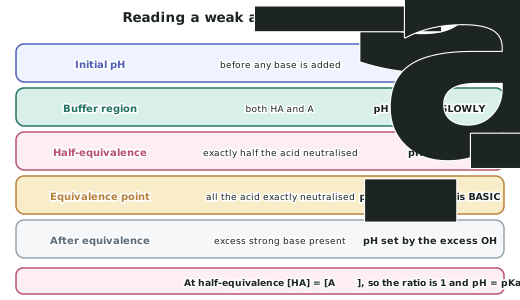
- The initial pH is higher — a weak acid is only partly dissociated, so starts much lower than for a strong acid of the same concentration.
- A buffer region appears in the early-to-middle part, where the pH changes only slowly. Here both and are present in quantity, so the solution is a buffer.
- The half-equivalence point sits in the middle of that region. Exactly half the acid has been converted, so and
- The equivalence point is above pH 7, because the salt formed contains the conjugate base of a weak acid, which reacts with water:
Reading the pKa off the graph
-
Find the equivalence volume from the steepest part of the curve.
-
Halve it to get the half-equivalence volume.
-
Read the pH at that volume. That value is the .
-
This is the quickest way to identify an unknown weak acid, and it requires no calculation at all.
Why the vertical section matters
- The vertical section is where a single drop of titrant changes the pH by several units.
- It is long for a strong acid + strong base, shorter for a weak acid + strong base, and essentially absent for weak + weak.
- A titration is only usable if there is a vertical section, because that is what makes the end point sharp — which is why the standard excludes weak + weak.
Worked ExampleA full weak acid titration
mL of mol L−1 ethanoic acid is titrated with mol L−1 sodium hydroxide. .
Calculate (a) the initial pH, (b) the volume of NaOH needed to reach equivalence, (c) the pH at half-equivalence, and (d) the pH at the equivalence point.
Part (a) — the initial pH
Before any base is added this is simply a weak acid solution:
Part (b) — the equivalence volume
At equivalence, moles of base = moles of acid.
Part (c) — the pH at half-equivalence
Half-equivalence is at 10.0 mL, where exactly half the ethanoic acid has been converted to ethanoate.
So , the ratio is 1, and
Part (d) — the pH at the equivalence point
Step 1 — Identify what is in the flask. All the ethanoic acid has been converted to ethanoate ion. The solution is now simply a solution of sodium ethanoate — a weak base.
Step 2 — Find its concentration, allowing for dilution. The total volume is now mL.
This dilution step is essential — the base has diluted the original solution nearly twofold.
Step 3 — Derive for the ethanoate ion.
Step 4 — Treat it as a weak base.
Step 5 — Convert to pH.