Species present and their relative concentrations
What the question asks
-
You are given a solution and must list every species present, in order of decreasing concentration.
-
This tests whether you can see what actually happens when a substance dissolves, and it appears on the paper most years.
-
Water is never listed — it is the solvent, and it is present in vast excess.
The method
- Write what the substance gives on dissolving.
- Decide which ion, if any, reacts with water — it is always the one derived from the weak partner.
- Write that equilibrium and identify the species it produces.
- Rank them by concentration.
Which salts react with water
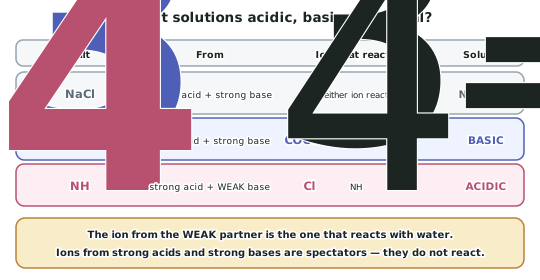
| Salt | From | Ion that reacts | Solution |
|---|---|---|---|
| strong acid + strong base | neither | neutral | |
| weak acid + strong base | basic | ||
| strong acid + weak base | acidic |
-
-
-
Ions from strong acids and bases — , , , — are spectators and do not react.
Ranking the species
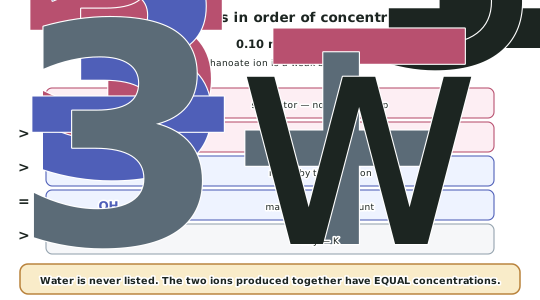
Three principles get the order right every time:
- The spectator ion is at its full concentration, because none of it is used up.
- The ion that reacts is slightly below that, because a little has been converted.
- The two products of that reaction are equal to each other, and both are small.
- The ion that is not produced — in a basic solution, in an acidic one — is the smallest, tied to the others by .
Worked orderings
mol L−1 — basic:
mol L−1 — acidic, no spectator:
mol L−1 — acidic:
- Note the equals signs. They are part of the answer, and questions often print an "=" between two of the boxes to tell you where they belong.
Linking concentration to conductivity
-
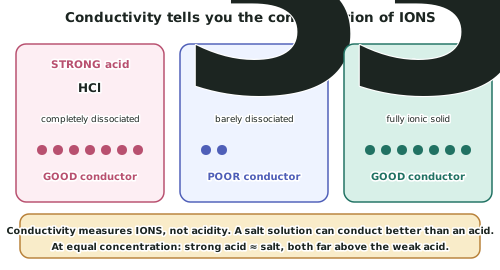
Conductivity depends on the total concentration of ions, whatever those ions are.
-
A salt solution is fully ionic, so it conducts well even if it is not acidic.
-
A weak acid is barely dissociated, so despite being acidic it conducts poorly.
-
So a solution's pH and its conductivity answer different questions, and a good answer uses each for what it shows.
Worked ExampleIdentifying three solutions from two measurements
Three colourless mol L−1 solutions — , and — have lost their labels and are relabelled A, B and C. Their conductivities and their colours with bromothymol blue (, yellow in acid, blue in base) are:
| Solution | Conductivity | Colour |
|---|---|---|
| A | poor | yellow |
| B | poor | blue |
| C | good | yellow |
Identify each solution, justifying your answer in terms of the degree of dissociation and the relative concentration of ions, and give relevant equations. No calculations are necessary.
Step 1 — Classify each substance
- — methylamine, a weak base. Only partly reacts with water, so few ions.
- — ethanoic acid, a weak acid. Only partly dissociates, so few ions.
- — an ionic salt. It is fully dissociated into and the moment it dissolves, so many ions.
Step 2 — Use the conductivity to find the salt
Conductivity depends on the total concentration of ions.
Only one solution conducts well, and only one substance is a fully ionised salt.
Its yellow colour with bromothymol blue confirms this is consistent — the solution should be acidic, because the ammonium ion is a weak acid:
The chloride ion is the conjugate base of a strong acid and is a spectator.
Step 3 — Use the indicator colour to separate the two weak electrolytes
A and B both conduct poorly, so both are the weakly dissociated substances — the weak acid and the weak base. The indicator separates them.
A is yellow → acidic → it must be the weak acid.
Only a small fraction of the molecules dissociate, so the concentration of ions is low and the conductivity is poor.
B is blue → basic → it must be the weak base.
Again only a small fraction reacts, so few ions are present and the conductivity is poor.