pH of weak acids and bases
Why a weak acid needs more work
- For a strong acid, equals the concentration of the acid, so the pH is one step away.
- For a weak acid only a small fraction dissociates, so is much less than the concentration and must be calculated from .
The method
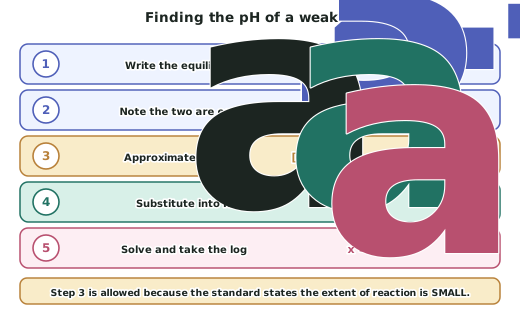
- Write the equilibrium:
- Note that the two ions are produced in a 1:1 ratio, so .
- Approximate the acid: , its initial concentration.
- Substitute into the expression:
- Solve and take the log:
Why the approximation is allowed
-
Strictly, at equilibrium is , because some of the acid has dissociated.
-
But EN6 of the standard states that the acids and bases you meet are those "in which the extent of reaction is small so that the equilibrium concentration of a dissolved weak acid or base can be approximated by the initial concentration".
-
So , and you may use the initial concentration throughout.
-
For a typical weak acid, is around 1 % of , so the error introduced is negligible.
Weak bases: derive first
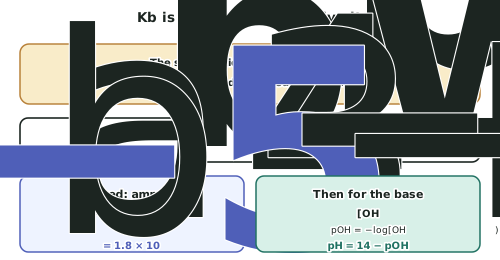
- The specification says values will not be provided, but may be derived. You get given the of the conjugate acid instead.
- Then the calculation mirrors the acid case, but produces hydroxide ions:
- Finish by converting to pH, either via or via .
The steps for a weak base
-
Identify the conjugate acid and look up its .
-
Derive .
-
Calculate .
-
Convert: , then .
-
That is four steps rather than two — leaving out the derivation or the conversion is where the marks go.
Percentage dissociation
- Sometimes you are asked how much of the acid has dissociated:
- A typical weak acid gives around 1 %, which is what justifies the approximation above.
Worked ExampleA weak acid and a weak base
Calculate, at 25 °C:
(a) the pH of mol L−1 ethanoic acid, (b) the pH of mol L−1 ammonia, given
Part (a) — the weak acid
Step 1 — Write the equilibrium.
Step 2 — Set up the unknowns. The two ions are formed in a 1:1 ratio, so if then too.
Because the extent of dissociation is small, the acid concentration at equilibrium is approximately its initial value:
Step 3 — Substitute into .
Step 4 — Take the negative log.
Part (b) — the weak base
Step 1 — Derive . Ammonia is a weak base, and its conjugate acid is . The specification states will not be provided, so derive it:
Step 2 — Write the equilibrium.
Step 3 — Find the hydroxide concentration. Again the two ions are formed 1:1, and the extent of reaction is small so .
Step 4 — Convert to pH. This is the step that must not be forgotten.