Dissolving a precipitate
The principle
- A precipitate dissolves further if you remove one of its ions from solution.
- Removing a product shifts the dissolving equilibrium to the right, so more solid dissolves.
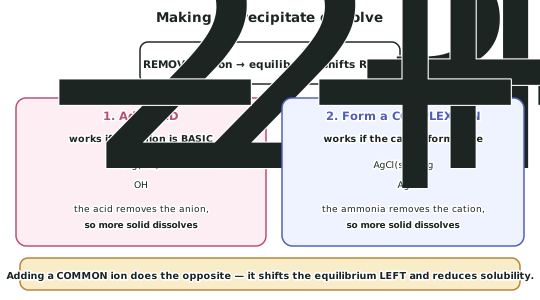
- This is the exact opposite of the common ion effect, which adds an ion and shifts the equilibrium left.
Method 1: add acid to remove a basic anion
- If the anion of the solid is a base, adding a strong acid protonates it and removes it from solution.
For magnesium hydroxide:
-
The acid consumes the hydroxide, so falls, the first equilibrium shifts right, and the solid dissolves.
-
This only works if the anion is basic. Hydroxides, carbonates and fluorides dissolve in acid; chlorides, nitrates and sulfates essentially do not, because , and are very weak bases.
Method 2: form a complex ion
- If the cation forms a complex ion with an added reagent, that reagent removes the cation.
For silver chloride with ammonia:
- The ammonia ties up the silver ion, so falls, the first equilibrium shifts right, and the precipitate dissolves.
The nine complex ions
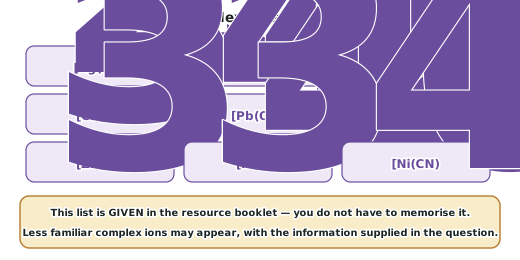
The specification says knowledge of these will be assumed, and the list is given in the resource booklet:
- Note the hydroxide complexes: , and dissolve in excess sodium hydroxide by forming , and .
- Less familiar complex ions may appear, but the question will supply the information.
The three-way summary
| Addition | Effect on the ion | Equilibrium shift | Solubility |
|---|---|---|---|
| common ion | adds one of the ions | left | decreases |
| acid (basic anion) | removes the anion | right | increases |
| complexing agent | removes the cation | right | increases |
| ion with nothing in common | no change | none | unchanged |
A hydroxide that goes both ways
- Adding a little sodium hydroxide to a solution of precipitates — the hydroxide is a common ion and also a reactant.
- Adding excess sodium hydroxide redissolves it, by forming .
- So the same reagent first precipitates and then dissolves, depending on how much is added.
Worked ExampleChoosing a reagent to dissolve a precipitate
A saturated solution of silver chloride is in contact with solid AgCl. Four solutions of the same concentration are available:
Select and justify an appropriate solution to add in order to (a) increase and (b) decrease the solubility of the silver chloride, including relevant equations. (c) Explain why the remaining two have little or no effect.
The equilibrium under consideration
Every option must be tested by asking: does it add or remove one of these two ions?
Part (a) — to INCREASE the solubility: add
Step 1 — Identify the reaction. Ammonia forms a complex ion with the silver ion — one of the nine in the resource booklet:
Step 2 — Explain the consequence. This reaction removes from solution, and silver ion is a product of the dissolving equilibrium.
By Le Châtelier's principle the dissolving equilibrium shifts right to replace the silver ion that has been removed.
Part (b) — to DECREASE the solubility: add
Step 1 — Identify the common ion. Sodium chloride supplies chloride ions, which are already a product of the equilibrium. Chloride is therefore the common ion.
Step 2 — Explain the consequence. Increasing causes the equilibrium to shift left to oppose the change.
Part (c) — why the other two do little
— no effect. Potassium nitrate supplies and .
- Neither is a common ion with or .
- comes from a strong base and from a strong acid, so neither reacts with water.
- Neither forms a complex or an insoluble compound with the ions present.
Nothing is added to or removed from the equilibrium, so it does not shift.
— essentially no effect, and this one is a trap. It is tempting to assume acid dissolves precipitates, but that only works when the anion is basic.
Here the anion is , the conjugate base of hydrochloric acid — a strong acid. Chloride is therefore an extremely weak base and is not protonated by nitric acid to any significant extent.
The nitrate ion is likewise a spectator, so nothing is removed and the equilibrium does not shift.