Proton transfer and conjugate pairs
The definitions
-
An acid is a proton donor — it gives away an .
-
A base is a proton acceptor — it takes an .
-
Every acid–base reaction is therefore a transfer of a proton from one species to another.
-
The standard describes aqueous systems as those "in which proton transfer occurs", so this is the language to use throughout.
Conjugate pairs
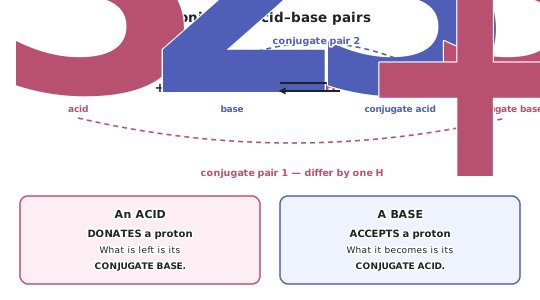
- When an acid donates its proton, what remains is its conjugate base.
- When a base accepts a proton, what it becomes is its conjugate acid.
- The two members of a conjugate pair differ by exactly one .
- There are two conjugate pairs in every such equation: and .
Finding a conjugate
-
Conjugate base: remove one — take away a hydrogen and make the charge one more negative.
- ;
-
Conjugate acid: add one — add a hydrogen and make the charge one more positive.
- ;
-
Change the charge, not just the hydrogen. Writing without its negative charge is the commonest slip here.
Water is amphiprotic
- Water can act as either an acid or a base, depending on what it meets.
- With an acid it acts as a base, accepting the proton to become .
- With a base it acts as an acid, donating a proton to become :
- This is why the same substance appears on both sides of the story throughout this topic.
The species you must recognise
The specification names these, and you are expected to know them without being told.
| Examples | |
|---|---|
| strong acids | , , , |
| strong bases | , |
| weak acids | , , |
| weak bases | , , |
- Note that and are a conjugate pair, and so are and . Recognising an ion as a weak acid or base is what lets you predict whether a salt solution is acidic or basic.
- Less familiar weak acids and bases may appear, but the question will supply the information you need.
Writing rather than
- A bare proton does not exist in water — it is always attached to a water molecule as the hydronium ion, .
- The booklet's relationships all use , so use that notation in your answers.
Worked ExampleIdentifying acids, bases and conjugates
For each equation, identify the acid, the base, and the two conjugate pairs.
(a) (b) (c) Write the equation for the reaction of the ethanoate ion, , with water, and explain why a solution of sodium ethanoate is basic.
(a)
Step 1 — Find what lost a proton. has become — it has lost an , so HF is the acid and is its conjugate base.
Step 2 — Find what gained one. has become — it has gained an , so water is the base and is its conjugate acid.
(b)
Step 1 — Find what gained a proton. has become — it has gained an , so methylamine is the base.
Step 2 — Find what lost one. Here has become — it has lost an , so this time water is the acid.
(c) Sodium ethanoate in water
Step 1 — Identify which ion reacts. Sodium ethanoate dissolves to give and .
comes from sodium hydroxide, a strong base, so it is a spectator and does not react with water.
is the conjugate base of the weak acid ethanoic acid, and the specification lists it as a weak base. So it does react.
Step 2 — Write the equation. As a base, the ethanoate ion accepts a proton from water:
Step 3 — Explain the pH. This reaction produces hydroxide ions, raising above .