Strong and weak acids and bases
Strength means how completely it dissociates
- A strong acid is completely dissociated in water — essentially every molecule has given up its proton.
- A weak acid is only partly dissociated — an equilibrium is set up, and most of the acid remains as undissociated molecules.
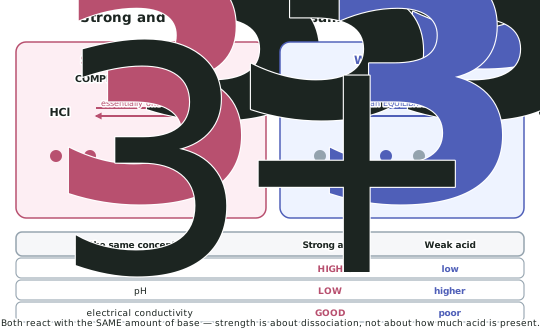
- Strong acid, written with a single arrow:
- Weak acid, written with equilibrium arrows:
Strong is not the same as concentrated
This distinction is examined every year, and it is worth stating in your own words.
-
Strong / weak describes how completely the acid dissociates — a property of the substance itself.
-
Concentrated / dilute describes how much acid is dissolved — a property of the solution you made.
-
So a concentrated weak acid and a dilute strong acid are entirely different, and either could have the lower pH depending on the numbers.
Comparing them at the same concentration
| Strong acid | Weak acid | |
|---|---|---|
| high — equals the acid concentration | low — much less than the acid concentration | |
| pH | low | higher |
| electrical conductivity | good | poor |
| rate of reaction with a metal or carbonate | fast | slower |
| volume of base needed to neutralise | the same | the same |
- That last row is the one people get wrong. Both contain the same amount of acid, so both need the same volume of base. Strength affects how much has dissociated at any moment, not how much acid is present in total.
Conductivity measures ions
-
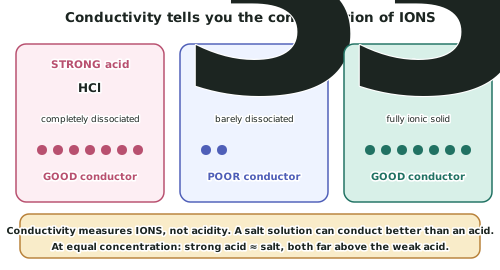
Electrical conductivity depends on the total concentration of ions in the solution.
-
A strong acid is fully dissociated, so it has a high ion concentration and conducts well.
-
A weak acid is barely dissociated, so it has a low ion concentration and conducts poorly.
-
A soluble salt is fully ionic even though it may not be acidic at all, so it also conducts well.
-
Conductivity is not a measure of acidity. A solution of sodium ethanoate conducts far better than ethanoic acid of the same concentration, yet it is basic.
measures strength numerically
- A larger means the equilibrium lies further right, so the acid is stronger.
- , so a smaller means a stronger acid.
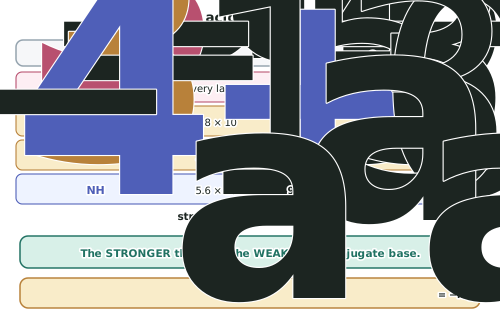
- Because is a negative log, the direction reverses: HF with is a stronger acid than ethanoic acid with .
The conjugate relationship
-
The stronger the acid, the weaker its conjugate base, and vice versa.
-
is a strong acid, so is such a weak base that it does not react with water at all.
-
is a weak acid, so is a reasonable base and does react with water.
-
This is why salt solutions can be acidic or basic, and it is the link between this page and the last.
Worked ExampleIdentifying solutions from their properties
Three colourless solutions, all mol L−1, have lost their labels. They are , and . Their conductivities and pH values are given below.
| Solution | Conductivity | pH |
|---|---|---|
| A | good | 8.9 |
| B | poor | 2.9 |
| C | good | 1.0 |
Identify A, B and C, justifying each in terms of the species present.
Step 1 — Work out what each substance should do
- HCl is a strong acid: completely dissociated, so mol L−1 and there are many ions.
- is a weak acid: only slightly dissociated, so mol L−1 and there are few ions.
- is a salt: it is fully ionic, so it has many ions, but the ethanoate ion is a weak base so the solution will be basic.
Step 2 — Use the pH to sort acidic from basic
Solution A has pH 8.9, which is above 7 — it is the only basic solution.
Only one of the three is basic: sodium ethanoate, because accepts a proton from water:
Step 3 — Separate the two acids by conductivity and pH
B and C are both acidic, so they are the two acids. Both differ sharply in both properties.
Solution C: pH 1.0 and good conductivity. A pH of 1.0 means mol L−1 — exactly equal to the concentration of the acid.
That can only happen if the acid is completely dissociated, and the high ion concentration explains the good conductivity.
Solution B: pH 2.9 and poor conductivity. A pH of 2.9 means mol L−1, which is far less than 0.100 — only about 1.3 % of the acid has dissociated.
The solution therefore contains mostly undissociated molecules and few ions, which is why it conducts poorly.