Buffer calculations
The one relationship you need
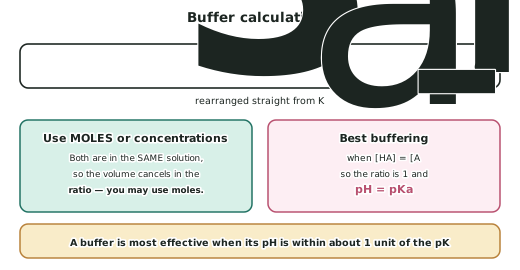
- The booklet gives you the expression. Rearrange it and every buffer calculation follows:
- The acid is on top and the conjugate base underneath. Inverting this is the commonest error, and it puts the pH on the wrong side of the .
Moles or concentrations — both work
- The acid and its conjugate base are in the same solution, so they share the same volume.
- In the ratio that volume cancels, so you may use moles directly.
- This saves a step and avoids errors, especially when a solid is added to a solution.
When the ratio is 1
- If , the ratio is 1 and , so
- This is the buffer's most effective composition, because it has equal capacity against added acid and added base.
- It is also how the is read off a titration curve at the half-equivalence point.
Choosing a buffer
- To make a buffer of a given pH, choose a weak acid whose is close to that pH, then adjust the ratio.
- A buffer works well within about one pH unit of its — beyond that the ratio becomes lopsided and one component runs low.
The three question types
- Find the pH from given amounts of acid and base. Substitute the ratio and take the log.
- Find the ratio or an amount needed for a target pH. Work backwards: find , then rearrange for the unknown.
- Find the new pH after adding acid or base. Adjust the moles of each component first, then substitute.
Adjusting the amounts
When a strong acid or base is added, work out the new amounts before touching the expression:
| Added | Reacts with | ||
|---|---|---|---|
| the conjugate base | increases | decreases | |
| the weak acid | decreases | increases |
- Both change by the same number of moles as the amount added.
Worked ExampleMaking a buffer of a specified pH
A chemist needs a buffer of pH . They start with mL of mol L−1 ethanoic acid and add solid sodium ethanoate.
Calculate the mass of sodium ethanoate required. Assume the volume does not change when the solid dissolves.
, g mol−1
Step 1 — Find the hydronium concentration needed
Step 2 — Rearrange the buffer relationship for
Step 3 — Substitute
Step 4 — Convert to moles, then to mass
The volume is mL L:
Step 5 — Check the answer is sensible
The target pH of 4.50 is below the , so the buffer must contain more acid than conjugate base.
Our answer gives and — the acid is in excess, by a ratio of about 1.8 : 1 ✓