The common ion effect
What it is
- A common ion is an ion that is already present in the solution and is also one of the ions of the sparingly soluble solid.
- Adding a common ion decreases the solubility of that solid.
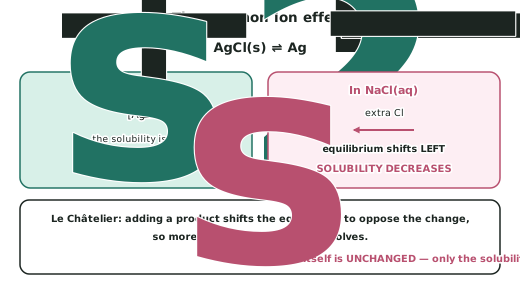
Why it happens
Consider a saturated solution of silver chloride:
- Adding sodium chloride solution increases — a product of this equilibrium.
- By Le Châtelier's principle the equilibrium shifts to oppose the increase, so it moves left.
- More solid forms, and less of it dissolves.
The solubility decreases, but itself is unchanged.
does not change
- This distinction is worth stating carefully, because questions test it.
- is a constant at a given temperature. Adding a common ion does not alter it.
- What changes is the balance between the two ion concentrations. One goes up, so the other must come down to keep their product equal to .
Calculating solubility with a common ion
-
Write the expression as usual.
-
Set the common ion's concentration equal to that supplied by the added salt — the solid contributes so little that its own contribution is negligible.
-
Let the other ion's concentration equal .
-
Solve for .
-
This is much easier than the pure-water case, because there is no square or cube root to take.
The size of the effect
For , :
| Solvent | Working | Solubility |
|---|---|---|
| pure water | mol L−1 | |
| 0.10 mol L−1 NaCl | mol L−1 |
- That is a reduction by a factor of about 7400. The effect is large, which is why it is used deliberately.
Where it is used
- Washing a precipitate with a dilute solution of one of its own ions, rather than pure water, minimises the amount that redissolves and is lost.
- In gravimetric analysis, a slight excess of the precipitating reagent is added for exactly this reason.
Worked ExampleComparing solubility in water and in a common ion solution
Calculate the solubility of silver chloride
(a) in pure water, and (b) in mol L−1 sodium chloride solution,
and explain the difference.
Part (a) — in pure water
Both ions come only from the dissolving solid, so :
Part (b) — in 0.10 mol L−1 NaCl
Step 1 — Identify the common ion. Sodium chloride supplies chloride ions, which are also produced by the dissolving AgCl. So is the common ion.
Step 2 — Set the chloride concentration. The chloride comes from two sources: the added NaCl at 0.10 mol L−1, and the dissolving AgCl at .
But part (a) showed is only about in pure water, and the common ion will make it smaller still. So the AgCl contribution is utterly negligible beside 0.10:
Step 3 — Set the silver concentration. Silver ions come only from the dissolving AgCl, so
Step 4 — Solve. No root is needed this time.
Step 5 — Explain the difference