Choosing an indicator
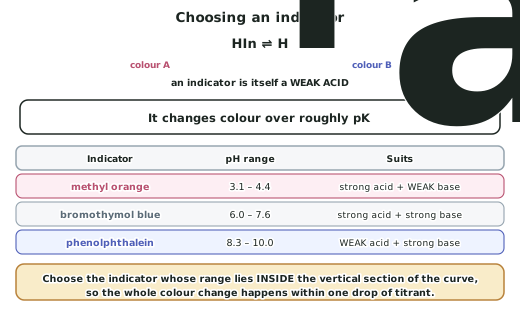
An indicator is itself a weak acid
- An acid–base indicator is a weak acid whose acid and base forms have different colours:
- In acidic solution the high pushes the equilibrium left, so you see colour A.
- In basic solution the removes , so the equilibrium shifts right and you see colour B.
The colour change range
- The colour you see depends on the ratio , and by the same rearrangement used for buffers:
- The eye detects a change when the ratio passes roughly between 10:1 and 1:10, which corresponds to
- So an indicator's useful range is about two pH units wide, centred on its own .
The three indicators to know
| Indicator | pH range | Suits |
|---|---|---|
| methyl orange | 3.1 – 4.4 | strong acid + weak base |
| bromothymol blue | 6.0 – 7.6 | strong acid + strong base |
| phenolphthalein | 8.3 – 10.0 | weak acid + strong base |
The selection rule
Choose an indicator whose pH range lies within the vertical section of the titration curve.
- Inside the vertical section, a single drop of titrant sweeps the pH through several units.
- If the indicator's whole range falls inside that section, the entire colour change happens within one drop — a sharp end point.
- If the range lies outside the vertical section, the colour changes gradually over several millilitres, and the titre cannot be read accurately.
Equivalence point and end point
-
The equivalence point is a fact about the stoichiometry — where the moles match exactly.
-
The end point is where the indicator changes colour.
-
A well-chosen indicator makes these two coincide; a poorly chosen one makes them differ, giving a systematic error in the titre.
-
So the practical question is always: does the indicator's range contain the pH at equivalence?
Worked ExampleSelecting indicators for two titrations
Using the indicator table above, select a suitable indicator for each titration and justify your choice.
(a) mL of mol L−1 ethanoic acid titrated with mol L−1 NaOH, where the equivalence point is at pH 8.79. (b) mL of mol L−1 HCl titrated with mol L−1 NaOH. (c) Explain what error would result from using methyl orange in titration (a).
(a) The weak acid titration
Step 1 — Note the equivalence pH. The equivalence point is at pH 8.79, which is above 7 because the salt formed, sodium ethanoate, contains the conjugate base of a weak acid.
Step 2 — Find an indicator whose range contains that pH.
| Indicator | Range | Contains 8.79? |
|---|---|---|
| methyl orange | 3.1 – 4.4 | no — far too low |
| bromothymol blue | 6.0 – 7.6 | no — changes too early |
| phenolphthalein | 8.3 – 10.0 | yes ✓ |
Step 3 — Justify. Its range of 8.3 – 10.0 contains the equivalence pH of 8.79, and that range lies within the vertical section of the curve.
The pH sweeps through the whole of 8.3 – 10.0 within one drop of NaOH, so the colour change is sharp and the end point coincides with the equivalence point.
(b) The strong acid titration
Step 1 — Find the equivalence pH. Both the acid and the base are strong, so the salt formed is NaCl. Neither nor reacts with water, so the equivalence point is at pH 7.00.
Step 2 — Select. Bromothymol blue, range 6.0 – 7.6, contains pH 7.00.
(c) The error from using methyl orange in (a)
Step 1 — Work out when methyl orange would change. Methyl orange changes over pH 3.1 – 4.4. In the ethanoic acid titration the pH passes through that range very early — in the buffer region, long before equivalence.
Recall that at half-equivalence the pH is already 4.76, above methyl orange's whole range. So the colour change would be complete before even half the acid had been neutralised.
Step 2 — Identify the consequence. The student would stop adding NaOH far too soon, recording an end point at roughly 5 mL instead of the true 20.0 mL.
Step 3 — Note the second problem. In the buffer region the pH is changing slowly, so the colour would drift through orange over several millilitres rather than changing within one drop. There would be no sharp end point at all, so the reading would also be imprecise as well as inaccurate.