How buffers work
What a buffer is
-
A buffer is a solution that resists a change in pH when a small amount of acid or base is added, or when it is diluted.
-
It contains both a weak acid and its conjugate base, in comparable amounts.
-
Two common ways to make one:
- mix a weak acid with a salt of that acid — ethanoic acid plus sodium ethanoate
- partly neutralise a weak acid with a strong base, so some acid and some conjugate base remain
Why both components are needed
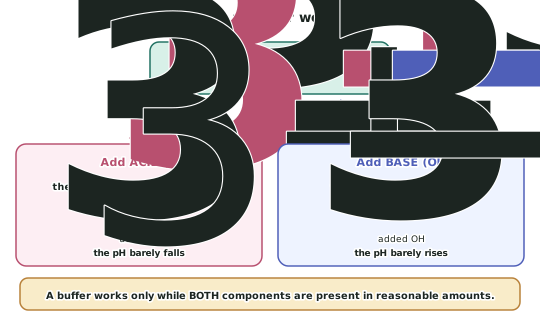
- The conjugate base deals with added acid:
- The weak acid deals with added base:
- In each case the added ion is converted into something that is already part of the buffer, so it is removed from solution and the pH barely moves.
- Both components are essential. A solution of ethanoic acid alone can absorb added base but not added acid, so it is not a buffer.
What actually changes
- Adding acid does change the buffer — it converts some into , so the ratio shifts.
- But because depends on the ratio , and both are present in large amounts, a small addition changes that ratio only slightly.
- So the pH changes — just very little.
Buffer capacity
-
A buffer only works while both components remain in reasonable quantity.
-
Add enough acid to consume all the conjugate base, and the buffer is exhausted — after that the pH falls sharply.
-
A buffer with larger amounts of both components has a greater capacity, even at the same pH.
-
Concentration affects capacity; the ratio affects pH. These are two separate things and questions test the distinction.
Buffers in the body and the lab
- Blood is buffered near pH 7.4, mainly by the carbonic acid / hydrogencarbonate pair.
- Buffers are used whenever a reaction must be run at a controlled pH — in enzyme work, in electroplating, and in the calibration of pH meters.
Worked ExampleHow much difference does a buffer make?
A buffer contains mol of ethanoic acid and mol of sodium ethanoate in L of solution. .
(a) Calculate the pH of the buffer. (b) Calculate the pH after mol of HCl is added, assuming no volume change. (c) Compare this with the pH change caused by adding mol of HCl to L of pure water.
Part (a) — the initial pH
Rearranging the expression:
The ratio is exactly 1, so
Part (b) — after adding acid
Step 1 — Decide what reacts. The added is removed by the conjugate base:
Step 2 — Adjust the amounts. 0.010 mol of ethanoate is consumed, and 0.010 mol of ethanoic acid is produced:
| Before | Change | After | |
|---|---|---|---|
| 0.100 | +0.010 | 0.110 mol | |
| 0.100 | −0.010 | 0.090 mol |
Step 3 — Recalculate.
Part (c) — the comparison
Adding 0.010 mol of HCl to 1.00 L of pure water gives mol L−1 directly, since HCl is a strong acid:
Pure water starts at pH 7.00, so the pH has fallen by 5.00 units.