pH, pOH and Kw
Water ionises itself
- Even pure water contains a few ions, because water molecules transfer protons to one another:
- The equilibrium constant for this is the ionic product of water, :
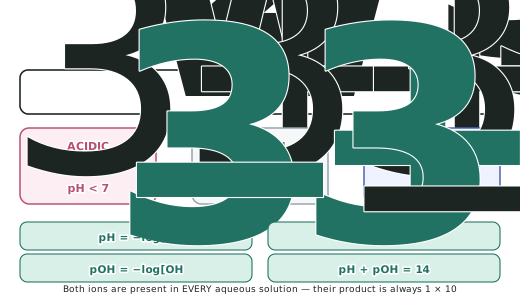
- Both ions are present in every aqueous solution, however acidic or basic. Their product is always at 25 °C.
- So if you know one, you can always find the other.
The relationships
All of these are supplied in the resource booklet:
- Two more follow directly, and are worth memorising:
Acidic, neutral and basic
| Relationship | pH | |
|---|---|---|
| acidic | < 7 | |
| neutral | = 7 | |
| basic | > 7 |
- In pure water both concentrations are mol L−1, which gives pH 7.
pH of a strong acid
- A strong acid is completely dissociated, so equals the concentration of the acid.
- Take the negative log and you have the pH — one step, no equilibrium.
pH of a strong base
-
A strong base is completely dissociated, so equals the concentration of the base.
-
But pH is defined from , so there is an extra step. Either route works:
- Via : find , then take the negative log.
- Via pOH: find , then .
-
This extra step is where marks are lost. Taking of a hydroxide concentration gives the pOH, not the pH.
The pH scale is logarithmic
- Each whole pH unit is a tenfold change in .
- pH 3 is ten times more acidic than pH 4, and a hundred times more acidic than pH 5.
- So diluting a strong acid tenfold raises its pH by exactly 1.
Significant figures for pH
- Only the digits after the decimal point in a pH count as significant figures.
- A concentration given to 3 significant figures gives a pH quoted to 2 decimal places — for example gives pH 2.88.
- Going the other way, a pH given to 2 decimal places supports a concentration to 2 significant figures.
Worked ExampleThree pH calculations
Calculate, at 25 °C:
(a) the pH of mol L−1 hydrochloric acid (b) the pH of mol L−1 sodium hydroxide (c) the concentration of hydroxide ions in a solution of pH
Part (a) — a strong acid
Step 1 — Use the fact that it is strong. Hydrochloric acid is a strong acid, so it is completely dissociated:
Every mole of HCl gives one mole of , so
Step 2 — Take the negative log.
Part (b) — a strong base
Step 1 — Use the fact that it is strong. Sodium hydroxide is a strong base, completely dissociated:
Step 2 — Find the pOH.
Step 3 — Convert to pH. This is the step that must not be skipped.
Part (c) — working backwards from a pH
Step 1 — Find from the pH.
Step 2 — Use to get the hydroxide concentration.