Predicting precipitation
The ionic product, Q
- is calculated with exactly the same expression as , but using the concentrations actually present rather than the equilibrium ones.
- Comparing with tells you which way the system must move.
| Comparison | Meaning |
|---|---|
| too many ions — a precipitate forms | |
| exactly saturated, on the point of precipitating | |
| no precipitate — more solid could still dissolve |
The method
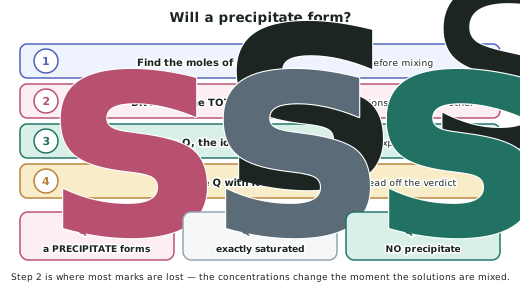
- Find the moles of each relevant ion, using on each solution separately.
- Divide by the TOTAL volume after mixing, to get the concentration of each ion in the mixture.
- Calculate , using the same expression as .
- Compare with and state the verdict.
Dilution is where the marks are
- The moment two solutions are mixed, both are diluted by the other.
- A solution of 25 mL mixed with 35 mL gives a total of 60 mL, and every ion concentration must be recalculated against that.
- Forgetting this is the single most common error in the topic. Using the original concentrations gives a that is far too large.
Watch the formula of the salt
- A salt may supply more than one of the relevant ion per formula unit.
- gives three sulfate ions per formula unit, so .
- Read the formula carefully before calculating moles.
Identifying which precipitate to test for
- When two solutions are mixed, ask which pair of ions could form a sparingly soluble solid.
- Mixing silver nitrate and sodium chloride, the possible products are and . Sodium nitrate is very soluble, so the only candidate is AgCl.
- Then test that combination against its own .
Worked ExamplePredicting a precipitate
mL of mol L−1 silver nitrate is mixed with mL of mol L−1 sodium chloride. Predict, by calculation, whether a precipitate of silver chloride will form.
Step 1 — Identify the possible precipitate
Mixing and could give AgCl or .
Sodium nitrate is very soluble, so the only candidate is silver chloride, and the equilibrium to consider is:
Step 2 — Find the moles of each ion before mixing
Each salt supplies one of the relevant ion per formula unit.
Step 3 — Find the total volume
This is the step that must not be skipped.
Step 4 — Find the concentration of each ion after mixing
Both are lower than in the original solutions, because each has been diluted by the other.
Step 5 — Calculate
Step 6 — Compare and conclude