Total quality management and continuous improvement
What total quality management is
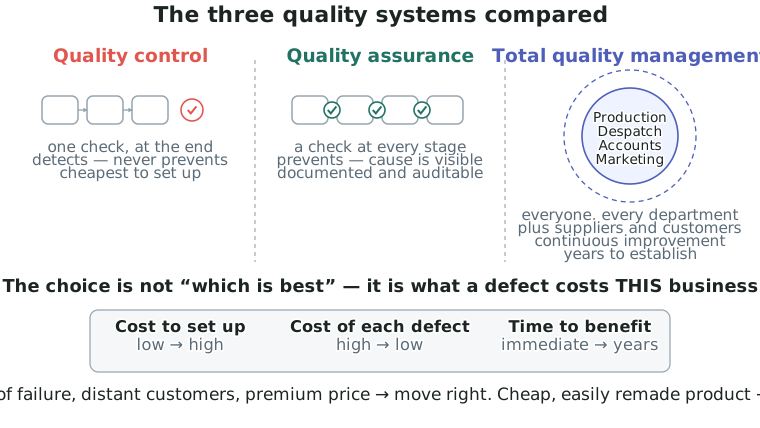
- Total quality management (TQM) goes further than quality assurance: quality becomes the responsibility of every person in the business, in every department, not just the ones who touch the product.
- The word that matters is total:
- every function — accounts, despatch, marketing and reception all have quality standards, because they all have customers
- every person — quality is part of everyone's job description, not a separate department
- the whole chain — suppliers and distributors are expected to meet the standard too
- TQM rests on the idea of the internal customer: the next person in the process is your customer, and you owe them work they can use without fixing it.
- It is a culture, not a procedure. That is why it takes years to establish and why it fails when management treats it as a set of forms.
The building blocks
- Continuous improvement (kaizen) — the belief that many small improvements, made constantly by the people doing the work, beat occasional large ones imposed from above.
- Improvements are cheap, low-risk and constant.
- The people who suggest them are the people who understand the job.
- Progress compounds: a 1% improvement made repeatedly is very large over years.
- Quality circles — small groups of employees from the same area who meet regularly to identify quality problems, investigate causes and propose solutions to management.
- They put the analysis where the knowledge is.
- They raise motivation, because staff see their suggestions implemented.
- They only work if management acts on the proposals; a circle whose ideas are ignored dies quickly.
- Zero defects as a target — not a claim that no defect will ever occur, but a refusal to build an "acceptable" level of failure into the plan.
- Getting it right first time — designing the process so the defect cannot be made, rather than catching it later.
Advantages
- The lowest defect rate of the three systems, because faults are designed out rather than caught.
- The lowest long-run cost, once established — less waste, less rework, fewer returns, fewer recalls.
- Improvement continues without further investment. The workforce keeps finding savings after the training has been paid for.
- Strong staff motivation and retention. People are trusted, consulted and see their ideas used.
- A powerful selling point. Reliability becomes a genuine differentiator, which supports a price premium.
- Values become explicit, so recruits tend to be people who share them, which reinforces the culture.
Disadvantages
- Slow. Establishing a TQM culture takes years, not months, and the benefits arrive after the costs.
- Expensive to introduce. Everyone in the business needs training, including staff who never touch the product.
- It requires sustained management commitment. If senior managers push output over quality the first time a deadline is tight, the culture collapses and staff stop believing in it.
- Resistance from staff and middle managers. Supervisors may see workers' new authority as a loss of their own.
- Meeting time is production time. Quality circles take people off the job.
- It can be over-engineered. A business whose customers do not value the extra reliability has spent money it cannot recover in price.
Choosing between the three systems
- The exam almost always frames this as a choice — "explain one benefit of using X rather than an alternative quality management system".
- The decision turns on three questions:
- How expensive is a defect for this business? Higher cost of failure pushes towards QA or TQM.
- How long is the payback? A business under short-term financial pressure may not survive the TQM investment period.
- What do the customers actually pay for? If they buy on price, the extra reliability may not be recoverable.