Types of intellectual property
What intellectual property is
- Intellectual property (IP) is what a business owns that has no physical form — its brand, its inventions, its designs, its recipes, its written and creative work.
- For many New Zealand exporters, IP is the business. The physical product can be copied; the brand, the formulation and the reputation are what cannot.
- IP matters more in a global business because the business is operating where it cannot watch. A competitor in a distant market can copy a product long before the owner notices.
The main types
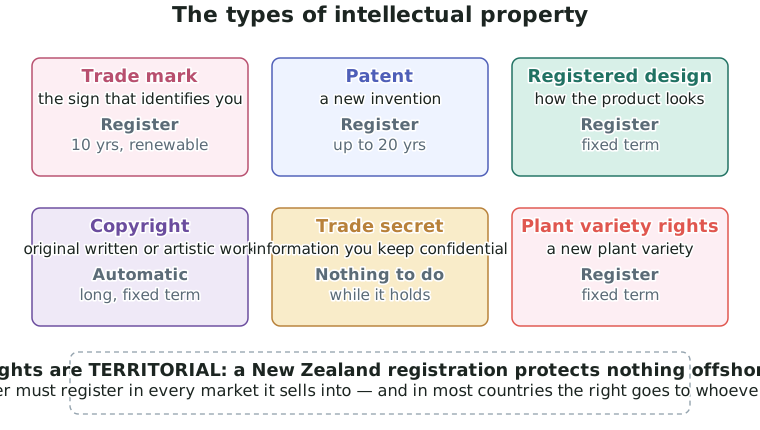
- Trade mark — a sign that identifies the business's goods or services: a name, a logo, a shape, sometimes a sound or colour.
- Registered per country, for renewable terms of ten years in New Zealand.
- It protects the identity, not the product. Anyone may make a similar oat bar; nobody may sell it under your name.
- Registration is what makes it enforceable, and it must be done in every market the business sells in.
- Patent — protection for a genuinely new invention: a device, a process, a composition.
- Requires the invention to be new, inventive and useful, and the application publishes how it works.
- Lasts up to twenty years, and again is granted country by country.
- Registered design — protects the appearance of a product: its shape, pattern or ornamentation.
- Copyright — protects original written, artistic, musical and software work.
- Arises automatically when the work is created; no registration is needed in New Zealand.
- Protects the expression, not the idea.
- Trade secret — information the business simply keeps confidential: a recipe, a supplier list, a process setting.
- Costs nothing and lasts as long as the secret holds.
- Has no protection at all once it leaks, and none against someone who works it out independently.
- Plant variety rights — protection for a new plant variety, which matters in New Zealand horticulture.
Choosing between patent and secrecy
- This is a genuine strategic decision, and a good source of an Excellence comparison.
- Patent:
- gives an enforceable monopoly for up to twenty years
- but publishes the invention, so competitors can read exactly how it works and design around it
- and is expensive to obtain and to enforce, in every country separately
- Trade secret:
- costs nothing and never expires
- but offers no protection once it is out, and none against reverse engineering
- and is only realistic where the secret can actually be kept — a formulation can be, a visible mechanism cannot
- The rule of thumb: patent what a competitor could see and copy; keep secret what they could not work out from the product itself.