Factors affecting business location
Why location is an internal factor
- Choosing where to put a factory, a warehouse, an office or a store is a management decision the business controls, which is why it sits in this standard rather than with external factors.
- It is a strategic decision: expensive, long-lived and hard to reverse. Moving a distribution warehouse is not something a business does twice.
- For a global business the question is not only where in New Zealand but which country — and the 2025 91381 paper turned exactly on whether to move a European distribution warehouse from Berlin to Rotterdam.
The factors
- Access to customers.
- Closer to the market means faster delivery, lower freight, and stock on the shelf when the customer wants it.
- For a service business, closeness to customers may be the entire decision.
- Access to suppliers and raw materials.
- Bulky, heavy or perishable inputs pull production towards the source — which is why dairy processing sits in dairying districts.
- Transport and infrastructure.
- Distance to a port or airport, the quality of roads and rail, and the reliability of power and internet.
- Port proximity is decisive for an exporter: every kilometre between the warehouse and the wharf is paid for on every container, both ways.
- Labour.
- Availability of the skills needed, the local wage rate, and whether the business can attract people to live there.
- Land and premises cost.
- Rent, lease or purchase price, and the space to expand later. Cheap land far from everything is not cheap once freight is counted.
- Legislation and regulation.
- Resource consents, zoning, environmental rules, employment law, tax rates and import duties. These differ sharply between countries.
- Government assistance.
- Grants, tax incentives or subsidised land offered by national or regional governments to attract investment.
- Exchange rates and political stability, for an overseas site — a low-cost country is not low cost if the currency or the government is unpredictable.
- Language and culture.
- The practical cost of operating where staff, suppliers and officials work in another language and by different business norms.
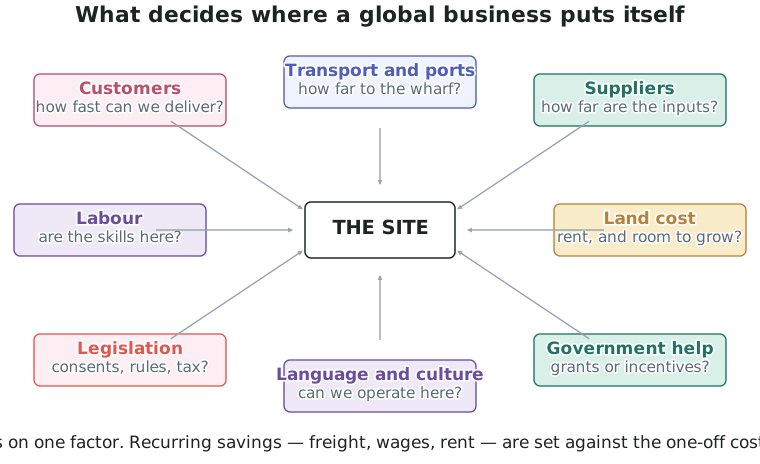
How the factors trade off
- Location decisions are almost never won on one factor. They are won on the combination that fits this business:
- A business whose product is cheap and heavy is dominated by freight, so it locates near the market or the port.
- A business whose product is light and valuable can locate almost anywhere, so it chases skills and cost.
- A business selling on speed of delivery pays for proximity to customers.
- A business selling on price chases the lowest total cost, including labour and land.
- The costs that decide it are often recurring — freight, wages, rent — while the costs of moving are one-off. A recurring saving eventually outweighs a large one-off cost; the appraisal question is how long "eventually" is.