Net present value
The idea behind it
- Money now is worth more than the same money later. Three reasons:
- money received now can be invested and earn a return
- inflation reduces what a future dollar will buy
- a future payment might not arrive — it carries risk
- Net present value (NPV) applies that idea to an investment: it converts every future cash flow back into today's money, adds them up, and subtracts what the investment costs.
- The rule: a positive NPV means the investment is worth more than it costs, so it should be accepted. Between two options, the higher NPV wins.
Discounting
- Converting a future amount into today's money is called discounting, and it is done by multiplying by a discount factor.
- The discount rate is the return the business could earn elsewhere, or the cost of the money it is using. A higher rate means future money is worth less today.
- Discount factors fall further the further out the year, because the money is waiting longer:
| Year | Factor at 10% |
|---|---|
| 1 | 0.909 |
| 2 | 0.826 |
| 3 | 0.751 |
| 4 | 0.683 |
- In the exam the factors are supplied. You multiply, add, and subtract.
Worked ExampleNet present value on the same machine
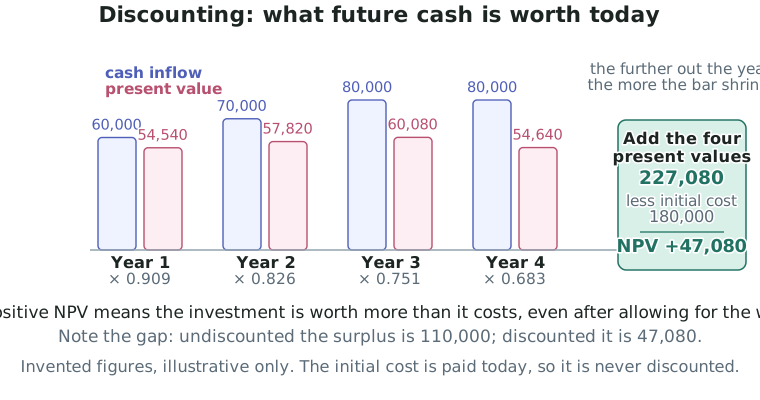
Using the same Kōwhai Coast Packaging figures (invented business, illustrative figures): initial cost $180,000; net cash inflows of $60,000, $70,000, $80,000 and $80,000; discount rate 10%.
Find the net present value.
Step 1 — Discount each year's cash flow
Multiply each inflow by its discount factor to get its value in today's money.
| Year | Cash inflow | Factor at 10% | Present value |
|---|---|---|---|
| 1 | $60,000 | 0.909 | $54,540 |
| 2 | $70,000 | 0.826 | $57,820 |
| 3 | $80,000 | 0.751 | $60,080 |
| 4 | $80,000 | 0.683 | $54,640 |
Step 2 — Add the present values
This gives what all the future cash is worth today.
54,540 + 57,820 + 60,080 + 54,640 = $227,080
Step 3 — Subtract the initial cost
227,080 − 180,000 = $47,080
NPV = +$47,080
What it means. Even after allowing for the fact that the money arrives over four years, the machine is worth $47,080 more than it costs. The NPV is positive, so on this measure Kōwhai Coast should buy it.
Note the difference from the raw figures. Undiscounted, the machine returns $290,000 on a $180,000 outlay — a surplus of $110,000. Discounting reduces that surplus to $47,080, because most of the return arrives in later years. That gap is exactly what NPV exists to reveal.
Advantages
- It is the only method that accounts for the time value of money, so it is the most theoretically complete.
- It uses all the cash flows, over the whole life.
- The answer is in dollars, so it tells you how much value is created, not just a rate.
- Risk can be built in by using a higher discount rate for a riskier project.
- It compares projects of different shapes directly — a slow starter against a fast one.
Disadvantages
- It depends entirely on the discount rate chosen, and that choice is a judgement. Change the rate and the ranking of two projects can flip.
- It relies on cash flow forecasts stretching years ahead, which are estimates. A precise calculation on uncertain inputs can look more reliable than it is.
- It is the hardest of the three to explain to non-financial staff, which matters when a decision has to be sold internally.
- A dollar answer is not comparable across sizes. A 180,000 machine is very different from the same NPV on a $2 million plant.