The role of innovation in business success
What innovation is
- Innovation is turning a new idea into something the business actually uses or sells. The standard defines it as originality, invention, commercialisation or improvement.
- The word commercialisation is doing work in that definition. An idea that never reaches a customer or a process is an invention, not an innovation.
- Innovation does not have to be a new product. It can be a new way of making, delivering, selling or organising.
The types of innovation
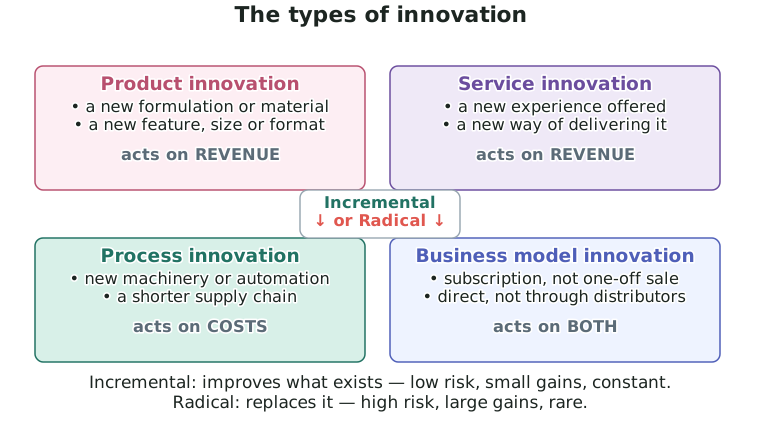
- Product innovation — a new or improved good.
- A new formulation, a new material, a new feature, a new size or format.
- Service innovation — a new or improved service, or a new way of delivering an existing one.
- The 2024 external used exactly this: an adventure tourism operator developing new experiences and new locations.
- Process innovation — a better way of making or delivering what the business already sells.
- New machinery, a redesigned layout, automation, a shorter supply chain. Usually invisible to the customer but visible in the unit cost.
- Business model innovation — a change in how the business makes its money.
- Subscription instead of one-off sale, direct-to-consumer instead of through distributors, licensing the brand instead of manufacturing.
- Incremental versus radical:
- Incremental innovation improves what exists. Low risk, small gains, constant.
- Radical innovation replaces it. High risk, large gains, rare.
Why innovation matters more to a global business
- Competing on cost is a losing game for New Zealand. A New Zealand business almost never has the cheapest labour or the shortest distance to market. What it can have is a product no one else is making, or a process no one else has.
- Differentiation supports a price premium. If the product is genuinely different, the buyer is not comparing it on price alone.
- Markets move. Consumer tastes, regulations and technology change faster in a business selling into many countries, so a product that stops changing eventually stops selling.
- Scale is not available. A New Zealand business usually cannot out-produce a multinational, so it competes on being first or being distinctive.
- Innovation defends the business as well as growing it. A competitor's innovation can destroy a market position that took decades to build.
How innovation shows up in the business's goals
- Revenue and market share — a genuinely new product opens sales that did not previously exist.
- Profit margin — process innovation lowers the unit cost; product innovation supports a higher price.
- Brand reputation — a business known for innovating attracts attention, distributors and staff.
- Survival — in a fast-moving market, standing still is a decision to lose share.
- Sustainability — process innovation is often where environmental gains come from: less energy, less packaging, less waste.