Payback period
What it measures
- The payback period is the time it takes for the net cash inflows from an investment to add up to the amount originally spent.
- It answers one question: how long is our money at risk?
- The rule: shorter is better, and a business normally sets a maximum payback it will accept ("we do not approve projects that take more than three years to pay back").
How to calculate it
- Step 1. Write down the cumulative cash flow year by year, starting from the negative initial cost.
- Step 2. Find the year in which the cumulative total crosses zero.
- Step 3. Work out the fraction of that year needed:
- fraction = amount still outstanding at the start of the year ÷ cash inflow during that year
- Step 4. Convert the fraction to months by multiplying by 12, if the question wants months.
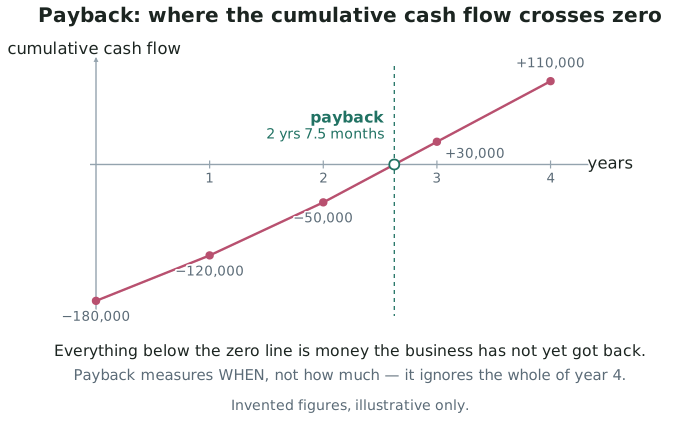
- Read the graph and the method becomes obvious: everything below the dashed zero line is money the business has not got back yet, and payback is simply the point where the line crosses it.
Worked ExamplePayback period on a labelling machine
Kōwhai Coast Packaging (invented business, illustrative figures) is considering a labelling machine costing $180,000, with net cash inflows of $60,000, $70,000, $80,000 and $80,000 over four years.
Find the payback period.
Step 1 — Build the cumulative cash flow
Start at the initial outflow and add each year's inflow.
| End of year | Cash inflow | Cumulative cash flow |
|---|---|---|
| 0 | — | −$180,000 |
| 1 | $60,000 | −$120,000 |
| 2 | $70,000 | −$50,000 |
| 3 | $80,000 | +$30,000 |
| 4 | $80,000 | +$110,000 |
Step 2 — Find where it crosses zero
The cumulative total is still negative at the end of year 2 (−$50,000) and positive at the end of year 3 (+$30,000), so payback happens during year 3.
Step 3 — Find the fraction of year 3 needed
At the start of year 3 the business is still $50,000 short, and year 3 brings in $80,000.
fraction = 50,000 ÷ 80,000 = 0.625 of a year
Step 4 — Convert to months
0.625 × 12 = 7.5 months
Payback period = 2 years and 7.5 months (about 2.6 years)
Advantages
- Simple to calculate and easy to explain to people who are not accountants.
- It is about cash, not profit, so it speaks directly to whether the business can survive the investment.
- It measures risk. Forecasts about year one are far more reliable than forecasts about year five, so a project that pays back early relies on less guesswork.
- Useful where technology changes fast, because a machine that pays back in two years does not have to still be competitive in year six.
- Good for a business short of cash, which is most small exporters.
Disadvantages
- It ignores everything after payback. A project returning $10,000 a year for twenty years after payback scores the same as one that stops the day it breaks even.
- It ignores total profitability. Payback tells you when, not how much.
- It ignores the time value of money. A dollar in year three is treated as identical to a dollar today.
- The maximum acceptable period is arbitrary. Why three years and not four?
- It biases the business towards short-term projects, which can mean rejecting exactly the long-lived investments — plant, research, market entry — that create lasting advantage.