Projectile motion: horizontal launch
What a projectile is
- A projectile is any object moving freely under gravity alone after being launched.
- Air resistance is ignored, so the only force acting is weight, straight down.
- Because the only force is vertical, the motion splits into two parts that do not affect each other.
The independence of horizontal and vertical motion
This is the key idea of the whole topic:
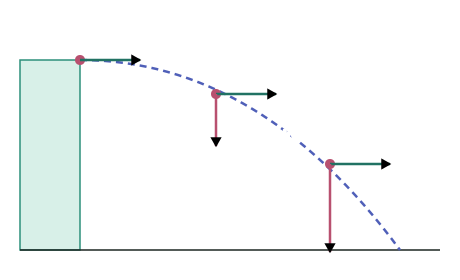
- Horizontally there is no force, so there is no acceleration — the horizontal velocity stays constant for the whole flight.
- Vertically the object accelerates downward at m s−2, exactly like an object in free fall.
- The only quantity the two directions share is time — both motions run for the same number of seconds.
- A ball rolled off a table and a ball dropped from the table edge at the same instant hit the floor together. The horizontal velocity of the first has no effect on how fast it falls.
Setting the problem out in two columns
Always split the given information before calculating:
| Horizontal | Vertical | |
|---|---|---|
| Acceleration | m s−2 down | |
| Initial velocity | = launch speed | (horizontal launch) |
| Equation to use | the four equations of motion |
- For a horizontal launch, the initial vertical velocity is zero — the object is not thrown up or down at all.
- The launch speed is entirely horizontal.
The standard order of solving
Nearly every horizontal-launch question is solved in the same three steps:
- Find the time of flight from the vertical motion.
- Use the drop height with .
- The horizontal speed is irrelevant here.
- Carry the time across to the horizontal motion.
- Find the range with .
- Find the final velocity components if asked.
- Horizontal: unchanged, still .
- Vertical: .
Combining the components at landing
- The actual velocity at any instant is the vector sum of the two components:
- The angle below the horizontal comes from:
-
— horizontal component (m s−1), constant
-
— vertical component (m s−1), growing throughout the flight
-
— angle of the velocity below the horizontal
-
Because stays fixed while grows, the path gets steeper and steeper — which is why the trajectory is a curve, not a straight diagonal.
Worked ExampleBall rolled off a cliff
A ball rolls off a cliff horizontally at m s−1. The cliff is m high. Find (a) the time to land, (b) how far from the base of the cliff it lands, and (c) its velocity as it lands.
Step 1 — Split the information into two columns
Horizontal: m s−1, . Vertical: (rolled off, so no initial vertical velocity), m s−2, m.
Step 2 — Time comes from the vertical motion alone
Step 3 — Carry the time across to the horizontal motion
No horizontal force, so the speed stays m s−1 for the whole s:
Step 4 — The landing velocity has two components
Horizontal (unchanged): m s−1. Vertical: m s−1 downward.
Combine them:
Worked ExampleWorking backwards from the range
A stunt cyclist rides horizontally off a ramp m above the ground and lands m away horizontally. How fast was she travelling when she left the ramp?
Step 1 — Recognise what is missing
The horizontal equation needs , which is not given. Get it from the vertical column.
Step 2 — Time of fall from the vertical motion
Step 3 — Now use the horizontal motion