Resolving forces into components
What resolving means
- Resolving is the reverse of adding: taking one force and replacing it with two perpendicular forces that together have the same effect.
- The two replacements are called the components of the force.
- Resolving is useful because it lets you deal with each direction separately — the same trick used for projectiles.
-
— size of the original force (N)
-
— angle between the force and the -direction
-
— component along the -direction (adjacent to the angle → cosine)
-
— component perpendicular to it (opposite the angle → sine)
-
Draw the force as the hypotenuse of a right-angled triangle with at the tail. Then adjacent → cosine, opposite → sine. This works no matter how the angle is measured.
Pulling at an angle
- A rope pulled at an angle above the horizontal on a sledge has:
- a horizontal component that does the useful pulling,
- a vertical component that lifts, reducing the normal force.
- Because the normal force drops, the friction drops too — which is why pulling a heavy case at an angle can be easier than pushing it flat.
- Pushing down at an angle has the opposite effect: it increases the normal force and so increases friction.
Objects on a slope
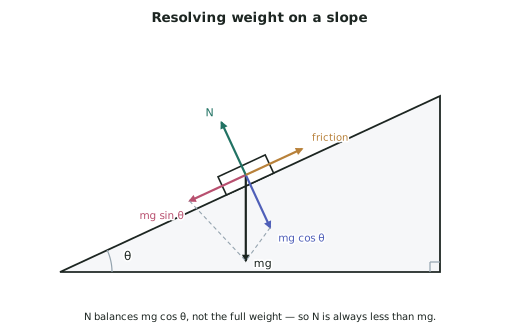
For an object on a slope inclined at to the horizontal, the natural axes are along the slope and perpendicular to it. Only the weight needs resolving:
-
— component of weight down the slope, which is what makes the object slide
-
— component into the slope, which the normal force balances, so
-
— angle of the slope above the horizontal
-
Sine goes with the slope angle here — a useful check is the extreme cases:
- a flat surface (): , nothing pulls it along, and . Correct.
- a vertical drop (): , it is in free fall, and . Correct.
-
The steeper the slope, the larger the component down the slope and the smaller the normal force — which is why things slide more easily on steep slopes.
Deciding which components you need
- Choose axes that suit the problem: horizontal/vertical for most, along/perpendicular to the surface for slopes.
- Resolve every force that is not already along one of your axes.
- Add the components along each axis separately.
- Apply to each axis on its own.
Worked ExampleA sledge pulled by an angled rope
A child pulls a sledge with a force of N along a rope at above the horizontal. The sledge has a mass of kg. Find (a) the horizontal and vertical components of the pull, and (b) the normal force from the ground.
Step 1 — Resolve the pull
Step 2 — Vertical forces on the sledge
Three forces act vertically: weight down, normal force up, and the N vertical component of the pull up. The sledge does not accelerate vertically, so they balance:
Worked ExampleA box on a ramp
A kg box sits on a ramp inclined at to the horizontal. Find (a) the component of its weight acting down the slope, (b) the normal force from the ramp, and (c) the friction force needed to hold the box still.
Step 1 — Find the weight
Step 2 — Resolve the weight along the two natural axes
Down the slope:
Into the slope:
Step 3 — Normal force
Perpendicular to the slope there is no acceleration, so the normal force balances :
Step 4 — Friction needed
The box is stationary, so along the slope the forces must also balance. Friction must act up the slope, matching the component of weight pulling it down: