Vector addition of forces
Why forces must be added as vectors
- Two forces of N and N do not always give N — the answer depends on their directions.
- The resultant (net force) is the single force that would have the same effect as all the others together.
- Adding vectors means placing them tip to tail: the resultant runs from the tail of the first to the tip of the last.
Forces along the same line
- Same direction: add the sizes. N right N right N right.
- Opposite directions: subtract, and the resultant takes the direction of the larger. N right N left N right.
- This is just choosing a positive direction and adding with signs.
Forces at right angles
When two forces are perpendicular, the tip-to-tail triangle is right-angled, so use Pythagoras and trigonometry:
-
— size of the resultant (N)
-
— the two perpendicular forces (N)
-
— angle of the resultant from
-
Always state the direction as well as the size — a resultant force is a vector, so " N" is only half an answer.
-
N and N at right angles give exactly N, which makes the classic –– triangle worth recognising.
Drag the arrows below to see how two component forces combine into one resultant, and how the resultant changes as the angle between them changes:
Fₓ = F cosθ = 7.8 × cos40° = 6.0 N · F_y = F sinθ = 5.0 N
Drag the pink tip.
Forces at any angle: the scale diagram method
The assessment specification requires a ruler and a protractor, and this is what they are for.
-
Choose a scale and write it down, e.g. cm N.
-
Draw the first force to scale, in the correct direction, using the protractor.
-
Draw the second force starting from the tip of the first, again to scale and at the correct angle.
-
Join the tail of the first to the tip of the second — that line is the resultant.
-
Measure its length with the ruler and convert back using your scale.
-
Measure its angle with the protractor and state the direction clearly.
-
The order you draw the two forces in does not matter — the resultant comes out the same.
-
Keep the diagram large. A cm diagram gives a far more accurate answer than a cm one.
Choosing between the two methods
- Perpendicular forces — use Pythagoras and trigonometry; it is exact and quicker.
- Any other angle — a scale diagram is expected at Level 2, and is fully acceptable for full marks.
- Either way, state the direction using a compass point, "above the horizontal", or an angle from a named force.
Worked ExampleTwo forces at right angles
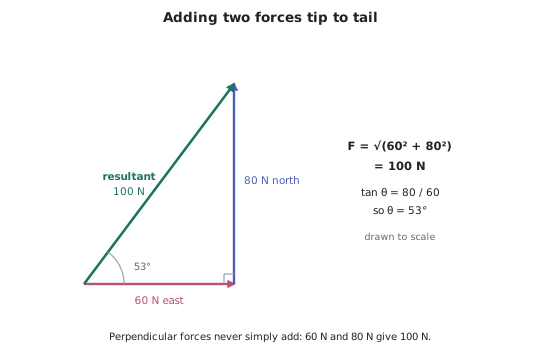
A boat is pushed by a N force due east and a N force due north. Find the resultant force on the boat.
Step 1 — Sketch the tip-to-tail triangle
Place the N east arrow first, then the N north arrow from its tip. The resultant runs from the start to the finish, and because the two forces are perpendicular the triangle is right-angled.
Step 2 — Size, by Pythagoras
Step 3 — Direction, by trigonometry
Measuring from east (the N direction):
Worked ExampleThree forces on one object
Three horizontal forces act on a crate: N east, N west, and N north. Find the resultant.
Step 1 — Combine the forces that lie along the same line
East and west are opposite, so take east as positive:
Step 2 — Now two perpendicular forces remain
N east and N north:
Step 3 — Direction