Projectile motion: launched at an angle
Splitting the launch velocity into components
- When a projectile is launched at an angle above the horizontal with speed , neither component is zero at the start.
- Resolve the launch velocity into two perpendicular components:
-
— launch speed (m s−1)
-
— launch angle above the horizontal
-
— horizontal component, constant for the whole flight
-
— initial vertical component, which then behaves like a ball thrown straight up
-
Cosine goes with the horizontal, sine goes with the vertical — when the angle is measured from the horizontal.
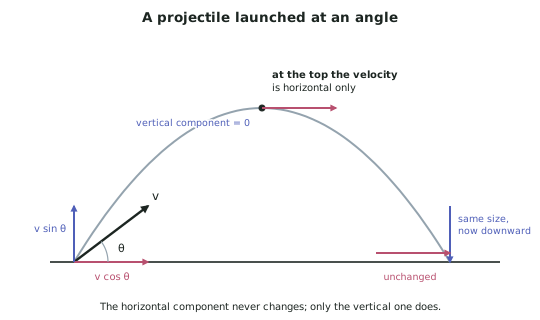
What each component does during the flight
- Horizontal: no force, so never changes. Horizontal displacement is always .
- Vertical: starts at upward, is slowed by gravity, reaches zero at the top, then grows downward.
- The path is symmetric about the highest point when the launch and landing heights are the same:
- time up = time down,
- the speed at landing equals the launch speed,
- the landing angle below the horizontal equals the launch angle above it.
The three quantities you are usually asked for
Maximum height — work in the vertical column with at the top:
Time of flight — find the time to the top, then double it (equal launch and landing heights):
Range — the horizontal distance covered in the whole flight:
- If the projectile lands at a different height from its launch (off a cliff, into a hole), the symmetry shortcut fails. Solve the vertical motion properly with equal to the height difference, using signs consistently.
How the launch angle changes the range
- For a given launch speed on level ground:
- the range is greatest at ,
- complementary angles give the same range — and land in the same place,
- a steeper angle gives more height and more air time but less range,
- a shallower angle gives more horizontal speed but far less time in the air.
- The trade-off is why wins: it is the angle that balances a large against a long .
Change the launch angle and speed below, then press Launch. Watch the range, maximum height and time of flight respond — and confirm for yourself that and land together:
Time of flight = 3.17 s · takes g = 9.8 m s⁻²
Velocity at any point in the flight
- Horizontal component: always .
- Vertical component at time : (taking up as positive).
- Combine for the actual velocity:
- At the highest point the velocity is not zero — the vertical component is zero, but the object is still moving horizontally at .
Worked ExampleFull analysis of an angled launch
A ball is kicked from level ground at m s−1 at above the horizontal. Find (a) the components of the launch velocity, (b) the maximum height, (c) the total time of flight, and (d) the range.
Step 1 — Resolve the launch velocity
Step 2 — Maximum height, from the vertical column
Take up as positive, so m s−2. At the top, :
Step 3 — Time of flight
Time to the top:
The ball lands at the same height it was launched from, so the flight is symmetric:
Step 4 — Range, from the horizontal column
Worked ExampleLanding lower than the launch point
A stone is thrown at m s−1 at above the horizontal from the top of a m cliff, out to sea. How long is it in the air, and how far from the base of the cliff does it land?
Step 1 — Resolve, taking up as positive
Step 2 — The symmetry shortcut does not apply
The stone lands m below its launch point, so set m (down is negative with this convention) and solve the vertical equation properly:
Step 3 — Solve the quadratic
This gives s or s. Time cannot be negative, so:
Step 4 — Range