Forces and free-body diagrams
What a force is
- A force is a push or a pull on an object. It is measured in newtons (N) and it is a vector.
- A force is always exerted by one object on another — name both when you describe it.
- A force can:
- change an object's speed,
- change its direction,
- change its shape.
The forces you meet at Level 2
- Weight () — the gravitational pull of the Earth on the object.
- Always acts vertically downward, from the centre of the object.
- is the mass in kg; m s−2.
- Mass and weight are not the same. Mass (kg) is the amount of matter and never changes; weight (N) is a force and depends on .
- Normal force () — the push of a surface on an object resting against it.
- Always acts perpendicular to the surface, not always vertically.
- Tension () — the pull of a string, rope or cable, along its length, away from the object.
- Friction — opposes relative motion between surfaces, acting along the surface.
- Air resistance / drag — opposes motion through a fluid, and grows with speed.
- Applied force — a push or pull from a person, engine or machine.
Drawing a free-body diagram
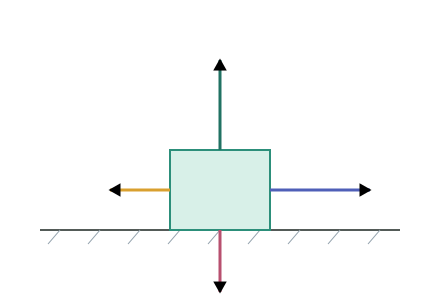
A free-body diagram shows every force acting on one object, and nothing else.
- Draw the object as a simple box or dot.
- Draw an arrow for each force, starting at the object and pointing the way the force acts.
- Make the length of each arrow roughly proportional to its size.
- Label every arrow with a name and, where known, a value in newtons.
- Include only forces acting on the object — never forces the object exerts on something else.
- Things students wrongly add to free-body diagrams:
- a "force of motion" or "forward force" on a coasting object — a moving object needs no force to keep moving,
- a "centrifugal force" pointing outward in circular motion,
- the object's own push on the ground — that acts on the ground, not on the object.
Net force
- The net force (or resultant, or unbalanced force) is the vector sum of all the forces on an object.
- If the net force is zero, the forces are balanced: the object stays at rest, or keeps moving at constant velocity.
- If the net force is not zero, the object accelerates in the direction of the net force.
- Add forces in one dimension by choosing a positive direction and adding with signs:
- two forces the same way: add them,
- two forces in opposite directions: subtract, and the answer takes the direction of the larger.
Worked ExampleWeight, mass and normal force
A kg box rests on a horizontal floor. (a) Calculate its weight. (b) State the size and direction of the normal force. (c) A person then presses down on the box with a force of N. State the new normal force.
(a) Weight
(b) The normal force with nothing else acting
The box is not accelerating vertically, so the vertical forces must balance:
(c) With an extra N push downward
The floor must now support the weight and the push:
Worked ExampleNet force in one dimension
A kg crate is pulled to the right with a force of N while friction of N acts on it. Draw the free-body diagram in words, and find the net force.
Step 1 — List the four forces acting on the crate
- Weight: N, downward
- Normal force: N, upward (no vertical acceleration, so these two balance)
- Applied force: N, right
- Friction: N, left (opposing the motion)
Step 2 — Vertical direction
The crate does not accelerate vertically, which is the check that the normal force was right.
Step 3 — Horizontal direction, taking right as positive