Distance–time graphs
What the axes mean
- A distance–time graph (or position–time graph) has time on the horizontal axis and distance from a starting point on the vertical axis.
- Each point on the line answers "where was it at that moment?"
- The line is not the path the object took. A straight line does not mean the object moved in a straight line — it means the distance grew steadily.
The gradient is the velocity
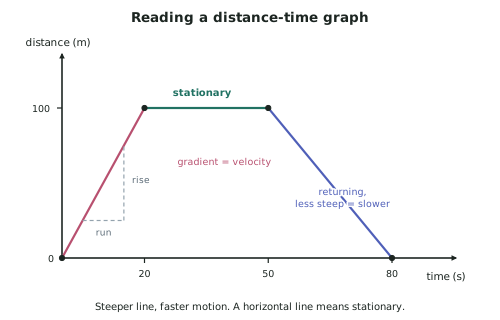
- A steeper line means a faster object.
- A horizontal line (zero gradient) means the object is stationary.
- A negative gradient means the object is returning toward the starting point.
To find a velocity from the graph:
- Choose two points on the line that are far apart and easy to read.
- Subtract to get the rise () and the run ().
- Divide: .
- Include the unit — m s−1.
Reading the shape
| Shape of line | What the object is doing |
|---|---|
| Horizontal | Stationary |
| Straight, sloping up | Constant velocity, moving away |
| Straight, sloping down | Constant velocity, returning |
| Steeper straight line | Same motion but faster |
| Curve getting steeper | Speeding up (accelerating) |
| Curve getting less steep | Slowing down |
- A curve on a distance–time graph always means the velocity is changing.
Instantaneous velocity from a curved graph
- The gradient of a curve is different at every point, so a single "rise over run" across the whole curve gives only the average velocity.
- To get the instantaneous velocity at one moment:
- Draw a tangent to the curve at that point — a straight line just touching the curve, with equal gaps above and below it either side.
- Extend the tangent a long way across the graph, so the triangle you read from is large.
- Find the gradient of that tangent.
- Use a ruler — the specification says you must bring one, and this is one of the places you need it.
Worked ExampleReading velocity from a three-stage journey
A cyclist's distance–time graph shows: a straight line from to ; a horizontal line from to ; then a straight line from back down to . Describe each stage and find the velocity in each.
Stage 1 — to s
The line rises steadily, so the velocity is constant and away from the start:
Stage 2 — to s
The line is horizontal: the distance is not changing, so the cyclist is stationary for s.
Stage 3 — to s
The line falls back to zero, so the cyclist is returning to the starting point:
The negative sign means the motion is back toward the start, at a speed of m s−1.
Worked ExampleDistinguishing average from instantaneous velocity
A car's distance–time graph is a curve that starts flat at the origin and steepens, passing through . A tangent drawn at s passes through and . Find the average velocity over the first s and the instantaneous velocity at s.
Step 1 — Average velocity uses the whole interval
Take the two end points of the interval, and :
Step 2 — Instantaneous velocity uses the tangent
The tangent touches the curve at s, so its gradient is the velocity at that moment: