Springs: force, extension, and stored energy
Key ideas
A spring stretched (or compressed) by a distance pulls (or pushes) back with a restoring force proportional to the extension — Hooke's law:
- is the spring constant (N m⁻¹) — how stiff the spring is.
- The minus sign says the spring's force is opposite to the extension: stretch it right, it pulls left. (When you just need sizes, use .)
The energy stored in a stretched spring is the elastic potential energy:
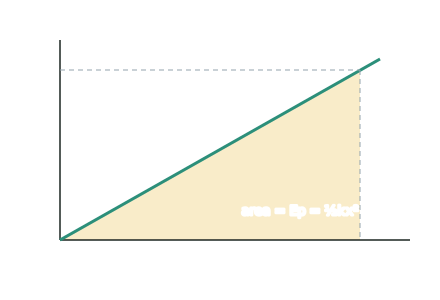
On a force–extension graph, the gradient is and the area under the line is the stored energy — the same graph-reading rules as motion graphs, wearing different units.
A spring with N m⁻¹ is stretched m. Find the force needed and the energy stored.
Step 1 — Force, from Hooke's law
Step 2 — Stored elastic potential energy
Practice question
A spring stretches m when a N weight hangs from it. Find the spring constant.
Worked solution: N m⁻¹.
Test yourself
Practice by grade
One question each at Achieved, Merit and Excellence. Have a go, then compare with the model answer.
A spring has a spring constant of N m⁻¹.
Calculate the force needed to stretch it by m.
A spring stretches m when a N weight hangs from it.
Calculate the spring constant, then the elastic potential energy stored in the spring at that stretch.
A spring of spring constant N m⁻¹ is compressed by m and used to launch a kg trolley along a frictionless track.
Calculate the launch speed of the trolley, and describe the energy transfer involved, using physics principles.