Circular motion and centripetal force
Key ideas
An object moving in a circle at constant speed is still accelerating — because its velocity's direction keeps changing. That acceleration points toward the centre of the circle:
By Newton's second law, something must supply the force toward the centre — the centripetal force:
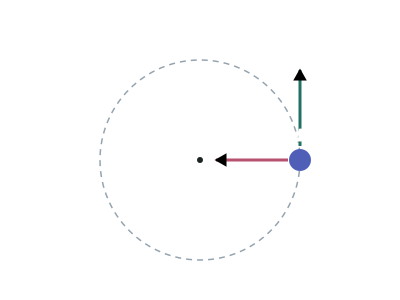
Centripetal force is not a new kind of force. It's the job description filled by a real force: friction (a car cornering), tension (a ball on a string), or gravity (the Moon orbiting Earth). At Level 2, one single force provides the centripetal force — that's stated in the standard.
A kg car takes a corner of radius m at m s⁻¹. Find the centripetal acceleration and the friction force needed.
Step 1 — Centripetal acceleration
Step 2 — The force that produces it
Friction between the tyres and road supplies this N.
Practice question
A kg ball is whirled on a string in a horizontal circle of radius m at m s⁻¹. Find the tension in the string.
Worked solution: N. The tension supplies the centripetal force.
Test yourself
Practice by grade
One question each at Achieved, Merit and Excellence. Have a go, then compare with the model answer.
A kg ball on a string is swung in a horizontal circle of radius m at a speed of m s⁻¹.
Calculate the centripetal force acting on the ball.
A car of mass kg rounds a bend of radius m at a constant speed of m s⁻¹.
Calculate the centripetal force required, and name the force that provides it.
A car rounds a corner at a constant speed.
Explain fully, using physics principles, why the car is accelerating even though its speed is constant, and describe what would happen if the road suddenly became icy.