Tariffs
What a tariff is
- A tariff is a tax on imported goods, charged at the border.
- Its purpose is usually to protect domestic producers from cheaper overseas competition.
- New Zealand has one of the lowest tariff regimes in the developed world, but tariffs remain on some goods — textiles, clothing and footwear are the standard example — and New Zealand exporters face tariffs in other countries, which is what free trade agreements negotiated by MFAT are designed to remove.
What it does to the model
- The tariff raises the price of imports by the tariff amount.
- The horizontal world supply line shifts up from Sw to Sw + tariff.
- The domestic demand and supply curves do not move.
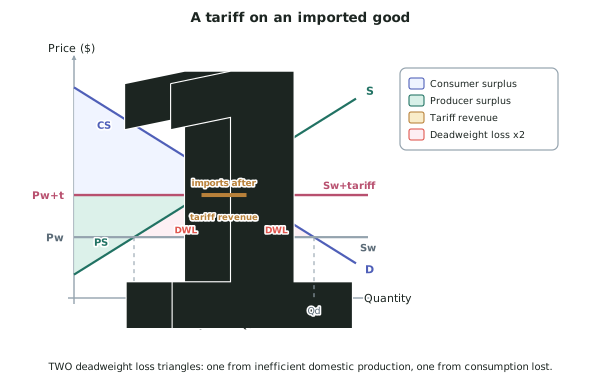
- At the higher price Pw + t:
- Domestic quantity supplied rises from Qs to Qs1 — a movement along the supply curve, because production is now more profitable.
- Domestic quantity demanded falls from Qd to Qd1 — a movement along the demand curve, because the good is less affordable.
- Imports shrink from Qd − Qs to the much smaller Qd1 − Qs1.
Who gains and who loses
Consumers
- Pay Pw + t instead of Pw, and consume Qd1 instead of Qd.
- Consumer surplus falls on both counts. This is the largest single effect of a tariff.
Domestic producers
- Receive Pw + t instead of Pw, on a larger output Qs1.
- Producer surplus rises on both counts. This is the intended effect.
- Note carefully: importers are a different group from domestic producers, and they are worse off — they sell less and hand the tariff to the government.
The government
- Collects tariff revenue — the rectangle with height t and width the quantity still imported, Qd1 − Qs1.
- The width is not total consumption. No tariff is collected on goods made in New Zealand.
Allocative efficiency
- TWO deadweight loss triangles, one on each side of the revenue rectangle:
- The production distortion, between Qs and Qs1. Domestic producers with costs above the world price are now producing, so those units cost New Zealand more than buying them overseas would have. Resources are wasted.
- The consumption distortion, between Qd1 and Qd. Consumers who valued the good at more than the world price have been priced out. Those trades no longer happen.
- Total surplus falls, so the market is allocatively inefficient.
The two triangles are the signature of this question
- Almost every tariff question asks you to shade and label both.
- Remember which is which by where it sits: the left triangle is about production (it is next to the supply curve), the right triangle is about consumption (it is next to the demand curve).
Worked ExampleWorking through a tariff completely
An illustrative New Zealand market imports a good at a world price of Pw = $20 per unit. At $20:
- Domestic quantity demanded is 90,000 units
- Domestic quantity supplied is 20,000 units
The government imposes a tariff of $8 per unit. At the new price of $28:
- Domestic quantity demanded falls to 70,000 units
- Domestic quantity supplied rises to 44,000 units
Calculate imports before and after and the government's tariff revenue, and explain the impact on each participant.
Step 1 — Show the change on the model
The Sw line shifts up from $20 to $28, by exactly the $8 tariff, and stays horizontal.
The domestic demand and supply curves do not move.
Step 2 — Imports before the tariff
Imports = Qd − Qs = 90,000 − 20,000 = 70,000 units
Step 3 — Imports after the tariff
Imports = Qd1 − Qs1 = 70,000 − 44,000 = 26,000 units
Imports fall by 44,000 units. They shrink from both ends: domestic production rises by 24,000 and domestic consumption falls by 20,000.
Step 4 — Government tariff revenue
Revenue is the tariff per unit multiplied by the quantity still imported.
Revenue = $8 × 26,000
Tariff revenue = $208,000
Note it is 26,000, not 70,000 — the government collects nothing on the 44,000 units now made in New Zealand.
Step 5 — Impact on consumers
Consumers pay $28 instead of $20 on the 70,000 units they still buy, and they no longer buy the 20,000 units between 70,000 and 90,000.
Consumer surplus falls on both counts, and this is the largest single loss caused by the tariff.
Step 6 — Impact on domestic producers
New Zealand producers receive $28 instead of $20, and expand output from 20,000 to 44,000 units.
Producer surplus rises on both counts. This is exactly what the tariff was designed to do.
Step 7 — Impact on importers
Importers are a different group and they are worse off. They bring in only 26,000 units instead of 70,000, and on each one they must pay $8 to the government. Their sales volume falls by nearly two thirds.
Step 8 — The two deadweight losses
Production distortion, between Qs = 20,000 and Qs1 = 44,000:
base = 24,000 units, height = 8 = $96,000
These 24,000 units are now made in New Zealand at a cost above $20 — the height of the domestic supply curve over that range is between $20 and $28. Buying them from overseas at $20 would have used fewer resources. That difference is wasted.
Consumption distortion, between Qd1 = 70,000 and Qd = 90,000:
base = 20,000 units, height = 8 = $80,000
These 20,000 units were worth more than $20 to consumers, and the world could supply them at $20. Those mutually beneficial trades no longer happen.
Total deadweight loss = 80,000 = $176,000
Step 9 — The verdict
Consumers lose more than producers and the government gain combined. The shortfall of $176,000 goes to nobody. Because a deadweight loss exists, the market is allocatively inefficient.