New Zealand as a price taker
What "price taker" means for a country
- New Zealand is a small open economy. For almost every internationally traded good, New Zealand's share of the world market is too small for its own decisions to change the world price.
- So New Zealand takes the world price as given. It is a price taker.
- On the model this is drawn as a horizontal world supply line at the world price, labelled Sw or Pw.
- Horizontal means New Zealand can buy or sell any quantity at Pw without moving it.
The export case: Pw above the domestic equilibrium
- If the world price is above what the domestic market alone would settle at, New Zealand producers will sell overseas rather than at home.
- The domestic price is pulled up to Pw.
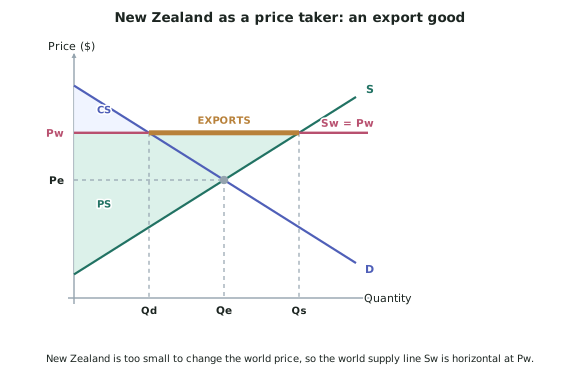
- At Pw:
- Domestic quantity supplied is Qs, read off the domestic supply curve.
- Domestic quantity demanded is Qd, read off the domestic demand curve.
- Qs is greater than Qd, and the gap Qs − Qd is exported.
- Consumers lose — they pay the higher world price and buy less. CS falls.
- Producers gain — they receive the higher world price on a larger output. PS rises.
- Total surplus rises, because the producers' gain exceeds the consumers' loss. Trading at the world price is allocatively efficient.
The import case: Pw below the domestic equilibrium
- If the world price is below the domestic equilibrium, consumers buy from overseas rather than at home.
- The domestic price is pushed down to Pw.
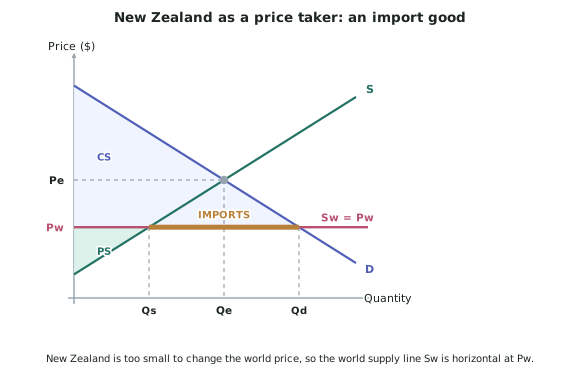
- At Pw:
- Domestic quantity demanded is Qd, which is greater than domestic quantity supplied Qs.
- The gap Qd − Qs is imported.
- Consumers gain — lower price, larger quantity. CS rises.
- Producers lose — lower price, smaller output. PS falls.
- Total surplus rises, because the consumers' gain exceeds the producers' loss.
Why free trade at the world price is efficient
- In both cases, moving from the closed domestic equilibrium to the world price increases total surplus.
- The gain is the triangle between the domestic demand and supply curves over the traded gap. It is the mirror image of a deadweight loss.
- One side always loses. Free trade is efficient overall, but it is not costless for everybody, and that distinction is what Excellence questions are built on.
New Zealand context
- Exports: dairy products, meat, logs and wood products, fruit (especially kiwifruit and apples), wine, seafood. New Zealand is a price taker in all of them.
- Imports: petroleum, vehicles, machinery, electronics, textiles and clothing.
- New Zealand's largest trading partners are China, Australia, the United States, Japan and the European Union (source: Stats NZ, overseas merchandise trade statistics).
Worked ExampleAn export market opening to trade
Before trade, an illustrative New Zealand market for a dairy product is in domestic equilibrium at Pe = $5.00 per kilogram and Qe = 60,000 tonnes.
The world price is Pw = $7.00 per kilogram. At $7.00:
- Domestic quantity demanded is 40,000 tonnes
- Domestic quantity supplied is 85,000 tonnes
Explain what happens to the domestic price, the quantity exported, and the surplus of each participant.
Step 1 — Which way does trade go?
The world price of $7.00 is above the domestic equilibrium of $5.00. New Zealand producers can get more overseas than at home, so this is an export market.
Step 2 — What happens to the domestic price
Producers will not sell domestically for $5.00 when they can get $7.00 overseas. Domestic consumers must therefore match the world price to get any of the product.
The domestic price rises from $5.00 to $7.00, and the world supply line Sw is drawn horizontally at $7.00.
Step 3 — Find the quantities at the world price
Read up from $7.00 across to each curve:
- Off the demand curve: domestic quantity demanded Qd = 40,000 tonnes — down from 60,000, because at $7.00 the product is less affordable for New Zealand consumers.
- Off the supply curve: domestic quantity supplied Qs = 85,000 tonnes — up from 60,000, because at $7.00 production is more profitable.
Step 4 — Find the quantity exported
Domestic producers make 85,000 tonnes but New Zealanders only buy 40,000.
Exports = Qs − Qd = 85,000 − 40,000 = 45,000 tonnes
Mark this as a horizontal measurement along the Pw line between Qd and Qs.
Step 5 — Impact on consumers
New Zealand consumers pay $7.00 instead of $5.00 and buy 40,000 instead of 60,000 tonnes.
Consumer surplus falls on both counts — the offset between price and quantity working against them on both sides. Domestic consumers are the losers from this export market.
Step 6 — Impact on producers
Producers receive $7.00 instead of $5.00, on 85,000 instead of 60,000 tonnes.
Producer surplus rises on both counts.
Step 7 — Impact on total surplus
The producers' gain is larger than the consumers' loss, because producers gain the extra $2.00 on a much greater quantity and also gain surplus on the 25,000 extra tonnes they now produce.
Total surplus rises, so opening this market to trade at the world price is allocatively efficient.
Step 8 — The distributional point
Efficiency does not mean everybody wins. New Zealand as a whole is better off, but New Zealand consumers of this product are worse off, paying a world price they have no ability to influence. That tension — efficient in total, unfavourable for one group — is the standard Excellence question in this part of the standard.