Market equilibrium and market forces
What market equilibrium is
- Market equilibrium is the price and quantity where quantity demanded equals quantity supplied.
- Written Qd = Qs, at the equilibrium price (Pe) and equilibrium quantity (Qe).
- On the model it is the single point where the demand curve crosses the supply curve.
- At equilibrium the market clears — every consumer willing to pay Pe gets the good, and every producer willing to supply at Pe sells it.
- There is no shortage and no surplus, so nothing is pushing the price to change.
Demand is not quantity demanded
This is the single most-corrected error in the whole standard, so get it exact.
- Demand is the whole curve — the entire relationship between price and quantity at every possible price.
- Demand changes when something other than price changes: income, tastes, the price of a substitute, population, expectations.
- A change in demand shifts the whole curve left or right.
- Quantity demanded is one point on the curve — the amount bought at one particular price.
- Quantity demanded changes when the price of the good itself changes.
- A change in quantity demanded is a movement along the curve.
- The same distinction applies exactly to supply and quantity supplied.
| If this changes | What moves | The right words |
|---|---|---|
| The good's own price | Along the curve | "quantity demanded falls" |
| Income, tastes, substitutes | The whole curve | "demand decreases" |
| The good's own price | Along the curve | "quantity supplied rises" |
| Costs of production, technology | The whole curve | "supply increases" |
How market forces clear a shortage
- A shortage exists when the price is set below equilibrium, so Qd > Qs.
- The horizontal gap between Qs and Qd at that price is the shortage.
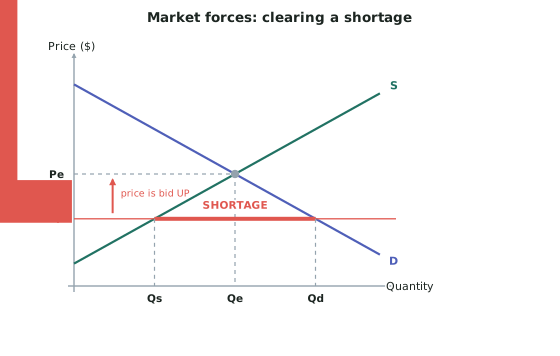
- The mechanism runs through affordability and profitability, and you must name both:
- Consumers who miss out bid the price up — they are willing to pay more rather than go without.
- As the price rises, the good becomes less affordable, so some consumers drop out and quantity demanded falls (a movement along the demand curve).
- As the price rises, production becomes more profitable, so producers supply more and quantity supplied rises (a movement along the supply curve).
- The two movements close the gap from both ends until Qd = Qs again at Pe.
How market forces clear a surplus
- A surplus exists when the price is set above equilibrium, so Qs > Qd.
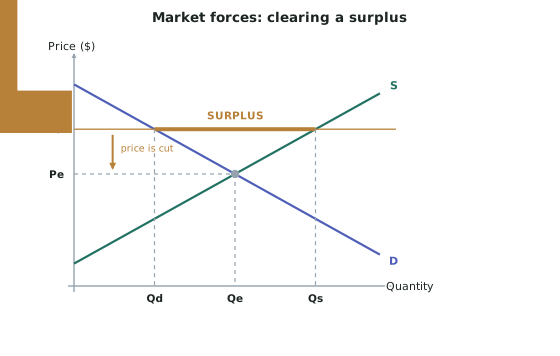
- The mechanism is the mirror image:
- Producers left with unsold stock cut the price rather than not sell at all.
- As the price falls the good becomes more affordable, so quantity demanded rises.
- As the price falls production becomes less profitable, so quantity supplied falls.
- The gap closes until Qd = Qs at Pe.
Why this page is worth so many marks
- The 2025 Assessment Report says outright: "How market forces work to restore equilibrium has consistently been in the exam in some form."
- It also names exactly what a good answer contains: "the basic principles of affordability and profitability and laws of demand and supply".
- An answer that says "the price will go back to equilibrium" describes the result but never explains the mechanism, and cannot get past Achieved.
Worked ExampleExplaining how equilibrium is restored
The illustrative market below is for a popular concert ticket. The equilibrium price is $120 and the equilibrium quantity is 4,000 tickets.
The promoter sets the price at $80. At $80, quantity demanded is 6,000 tickets and quantity supplied is 3,000 tickets.
Explain how market forces would restore equilibrium in this market. In your answer, refer to the concept of market forces.
Step 1 — Name the gap and give its size
At $80, quantity demanded (6,000) is greater than quantity supplied (3,000). There is a shortage of 3,000 tickets.
The price of $80 is below the equilibrium price of $120.
Step 2 — Say who acts, and why
Consumers who cannot get a ticket at $80 still want one, and some of them are willing to pay more than $80 rather than miss the concert. Competition between these consumers bids the price up from $80 towards $120.
Step 3 — What happens on the demand side, and why
As the price rises from $80 towards $120, tickets become less affordable. Some consumers who were willing to pay $80 are not willing to pay $100 or $120, so they leave the market.
Quantity demanded falls from 6,000 towards 4,000. This is a movement along the demand curve, not a shift — demand itself has not changed, only the price of the ticket.
Step 4 — What happens on the supply side, and why
As the price rises from $80 towards $120, selling tickets becomes more profitable, because the revenue per ticket rises while costs are unchanged. Producers are willing to release more seats.
Quantity supplied rises from 3,000 towards 4,000. Again this is a movement along the supply curve.
Step 5 — State where it stops
The two movements close the shortage from both ends. Once the price reaches $120, quantity demanded and quantity supplied are both 4,000, so Qd = Qs, the shortage is zero, and there is no further pressure on the price.
Equilibrium is restored at Pe = $120 and Qe = 4,000 tickets.