Subsidies
What a subsidy is
- A subsidy is a payment from the government to producers for each unit produced.
- It is the mirror image of an indirect tax.
- In New Zealand, Pharmac subsidises medicines so that the price patients pay at the pharmacy is far below the cost of supply.
- The exam uses a specific subsidy — a fixed number of dollars per unit.
What it does to the model
- The subsidy lowers the cost of supplying every unit by the subsidy amount.
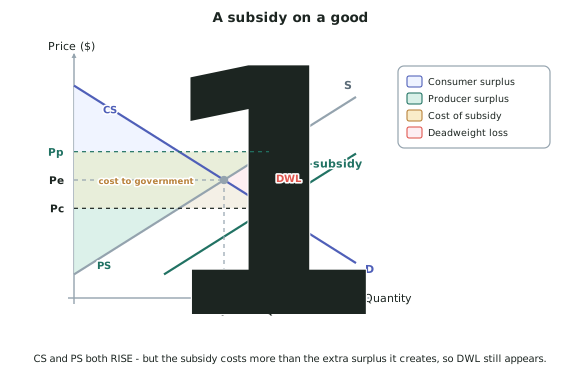
- Supply shifts down and to the right by the exact vertical distance of the subsidy, from S to S + subsidy.
- Again a parallel shift, and again an increase in supply, not a movement along the curve.
The four labels
| Label | What it is | Where it is |
|---|---|---|
| Pc | The price consumers pay — now lower than Pe | Where D meets S + subsidy |
| Pp | The price producers receive — now higher than Pe | Straight up from Q1 to the original S curve |
| Q1 | The new quantity — now greater than Qe | Below where D meets S + subsidy |
| Pp − Pc | The subsidy per unit | The vertical gap between the two supply curves |
- Both Pc and Pp move away from Pe in opposite directions, and the gap between them is the subsidy. Consumers pay less and producers get more, because the government is making up the difference.
The impact on each participant
Consumers
- Pay a lower price, Pc.
- Buy more, Q1.
- Consumer surplus rises on both counts.
Producers
- Receive more per unit, Pp.
- Sell more, Q1.
- Producer surplus rises on both counts.
The government
- Pays out the whole rectangle: height Pp − Pc, width Q1.
- This is a cost, funded by taxpayers, and it is paid on every unit including the ones that would have been sold anyway.
Allocative efficiency
- A deadweight loss triangle appears beyond Qe, between Qe and Q1, bounded by supply above and demand below.
- Over that range, units cost more to produce than any consumer values them at. They are only made because the subsidy pays the difference.
- Because a deadweight loss exists, the market is allocatively inefficient — this time through over-allocation of resources.
Why a subsidy is still inefficient when everybody seems better off
- Consumers gain, producers gain — but the government pays out more than those two gains combined.
- The difference is exactly the deadweight loss triangle.
- Over-allocation: resources are pulled into this market that were worth more producing something else.
Worked ExampleWorking through a subsidy completely
An illustrative market for a medicine is in equilibrium at Pe = $50 per prescription and Qe = 40,000 prescriptions.
The government introduces a subsidy of $30 per prescription. After the subsidy:
- Consumers pay Pc = $28
- Quantity rises to Q1 = 62,000 prescriptions
Calculate the price producers receive, the total cost to the government, and the deadweight loss.
Step 1 — Find the price producers receive
Producers receive what the consumer pays, plus the subsidy from the government.
Pp = Pc + subsidy = 30 = $58
So producers now receive $58, which is $8 more than the $50 they received before.
Step 2 — Split the benefit
Consumers gain the fall in what they pay:
Pe − Pc = 28 = $22 per prescription
Producers gain the rise in what they receive:
Pp − Pe = 50 = $8 per prescription
The two shares add to the $30 subsidy. Consumers capture $22 of the $30, so demand here is relatively inelastic compared with supply.
Step 3 — Calculate the cost to the government
The cost is a rectangle: the subsidy per unit, multiplied by every unit now sold.
Cost = subsidy × Q1 = $30 × 62,000
Cost to the government = $1,860,000
Note that the government pays the subsidy on all 62,000 prescriptions — including the 40,000 that would have been dispensed anyway.
Step 4 — Calculate the deadweight loss
The DWL triangle sits between Qe and Q1, to the right of the original equilibrium.
base = Q1 − Qe = 62,000 − 40,000 = 22,000 prescriptions height = the subsidy = $30
DWL = ½ × 22,000 × $30
Deadweight loss = $330,000
Step 5 — State the efficiency verdict
Consumers gain and producers gain, but the government pays $1,860,000, which is more than the two gains combined. The shortfall of $330,000 is the deadweight loss.
For the 22,000 extra prescriptions between Qe and Q1, the supply curve lies above the demand curve — they cost more to produce than consumers value them at. They are only dispensed because the subsidy covers the gap. Resources have been over-allocated to this market.
Because a deadweight loss exists, the market is allocatively inefficient.
Step 6 — The other argument
That verdict is about efficiency only. A government may still justify the subsidy on grounds of access — 22,000 more people receive treatment, and better health now reduces cost pressure on the health system later. That is an equity and long-term-cost argument, not an efficiency one, and it should be stated separately.