Indirect taxes
What an indirect tax is
- An indirect tax is a tax on a good or service rather than on income. It is collected by the producer and paid to the government.
- In New Zealand the two you will meet are GST, charged on almost everything, and excise duties, charged on specific goods such as alcohol, tobacco and fuel.
- The exam almost always uses a specific tax — a fixed number of dollars per unit — because it shifts the supply curve by the same vertical distance everywhere.
What it does to the model
- The tax raises the cost of supplying every unit by the tax amount.
- Supply shifts up and to the left by the exact vertical distance of the tax, from S to S + tax.
- Draw it as a parallel shift. The vertical gap between the two supply curves must equal the tax at every quantity.
- It is a decrease in supply, not a movement along the curve — the good's own price did not cause it.
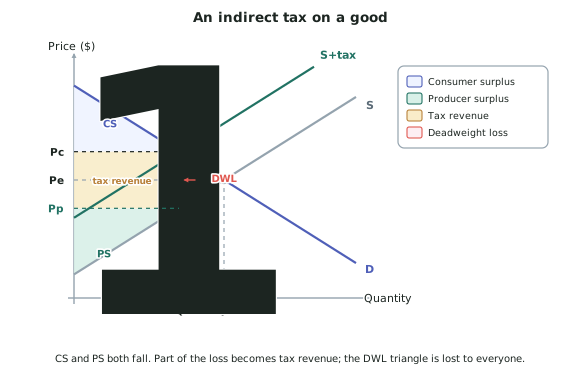
The four labels you must be able to find
| Label | What it is | Where it is |
|---|---|---|
| Pc | The price consumers pay | Where D meets S + tax |
| Pp | The price producers keep | Straight down from Q1 to the original S curve |
| Q1 | The new quantity traded | Below where D meets S + tax |
| Pc − Pp | The tax per unit | The vertical gap between the two supply curves |
- Pp is not on the new supply curve. It is on the original one. Producers receive Pc from the consumer and hand the tax to the government, keeping Pp.
The impact on each participant
Consumers
- Pay a higher price, Pc instead of Pe.
- Buy less, Q1 instead of Qe.
- Consumer surplus falls for both reasons — the offset between price and quantity.
Producers
- Keep less per unit, Pp instead of Pe.
- Sell less, Q1 instead of Qe.
- Producer surplus falls, again for both reasons.
The government
- Gains tax revenue — the rectangle with height Pc − Pp and width Q1.
- Note the width: revenue is collected only on the units still traded, not on Qe.
Allocative efficiency
- A deadweight loss triangle appears between Q1 and Qe, bounded by demand above and the original supply curve below.
- Total surplus is no longer maximised, so the market is allocatively inefficient.
Who actually pays the tax
- The legal payer is the producer. The economic burden is split, and the split is decided by elasticity, not by the law.
- The side that is less elastic pays more, because it cannot escape by leaving the market.
- With inelastic demand, Pc − Pe is large and Pe − Pp is small: consumers pay most.
- With elastic demand, Pc − Pe is small and Pe − Pp is large: producers pay most.
Worked ExampleWorking through a tax completely
An illustrative market for a soft drink is in equilibrium at Pe = $4.00 and Qe = 10,000 bottles.
The government imposes an excise duty of $1.50 per bottle. After the duty:
- The price consumers pay rises to Pc = $5.00
- Quantity traded falls to Q1 = 7,000 bottles
Calculate the price producers keep, the government's tax revenue, and the deadweight loss. Then explain the impact on each participant.
Step 1 — Find the price producers keep
Consumers pay $5.00. Of that, $1.50 goes to the government as duty.
Pp = Pc − tax = 1.50 = $3.00
Producers keep $3.00 per bottle — a dollar less than the $4.00 they kept before.
Step 2 — Split the burden
The consumer's share is the rise in what they pay:
Pc − Pe = 4.00 = $1.00 per bottle
The producer's share is the fall in what they keep:
Pe − Pp = 3.00 = $0.50 per bottle
Consumers bear $1.00 of the $1.50, or two thirds. This tells us demand here is relatively inelastic compared with supply.
Step 3 — Calculate government tax revenue
Tax revenue is a rectangle: the tax per unit, multiplied by the quantity still traded.
Revenue = tax × Q1 = $1.50 × 7,000
Tax revenue = $10,500
Note it is 7,000, not 10,000 — the government cannot collect duty on bottles nobody buys any more.
Step 4 — Calculate the deadweight loss
The DWL triangle sits between Q1 and Qe.
base = Qe − Q1 = 10,000 − 7,000 = 3,000 bottles height = the tax = $1.50
DWL = ½ × 3,000 × $1.50
Deadweight loss = $2,250
Step 5 — Explain the impact on each participant
Consumers. They pay $1.00 more per bottle on the 7,000 they still buy, and 3,000 bottles they used to buy they no longer do. Consumer surplus falls on both counts.
Producers. They keep $0.50 less per bottle and sell 3,000 fewer bottles. Producer surplus falls on both counts, but by less than consumers lose because their share of the tax is smaller.
The government. It gains $10,500 in revenue, which is a transfer from consumers and producers, not a loss to society.
Allocative efficiency. $2,250 of surplus is destroyed — the 3,000 bottles that were worth more to consumers than they cost to produce are no longer made, and that value goes to nobody. Because a deadweight loss exists, the market is now allocatively inefficient.