Elasticity and the size of every impact
Why elasticity is in this standard
- The 2026 Assessment Specification says it directly: "Candidates may be required to demonstrate an understanding of elasticity concepts."
- It is not decoration. Elasticity decides how big every effect on this course is:
- how much of a tax consumers pay versus producers,
- how much government revenue a tax raises,
- how large the deadweight loss is,
- how far the price moves when the world price changes.
- 2024 Question Three and 2025 Question One were both built entirely on this.
Price elasticity of demand
- Price elasticity of demand (PED) measures how responsive quantity demanded is to a change in price.
PED = % change in quantity demanded ÷ % change in price
- Ignore the negative sign when you interpret it — the sign is just the law of demand.
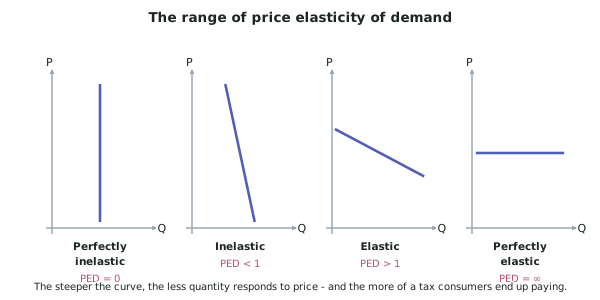
- PED > 1 — elastic. Quantity demanded changes proportionately more than price.
- PED < 1 — inelastic. Quantity demanded changes proportionately less than price.
- PED = 1 — unitary. They change in the same proportion.
What makes demand inelastic
- Few or no close substitutes — the strongest determinant by far. If nothing else will do, you buy it anyway.
- It is a necessity rather than a luxury.
- It takes a small share of income, so a price rise barely registers.
- It is addictive or habit-forming.
- The time period is short — consumers have not yet found alternatives.
What makes demand elastic
- Many close substitutes available.
- It is a luxury and easily gone without.
- It takes a large share of income.
- The time period is long, giving consumers time to switch.
- The good is narrowly defined — "Anchor milk" is far more elastic than "milk", which is more elastic than "food".
Elasticity and the burden of a tax
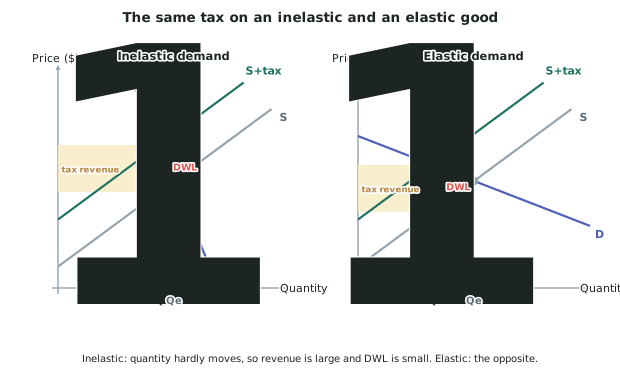
- Whoever is less responsive to price ends up carrying more of a tax. They cannot escape it by leaving the market.
| Inelastic demand | Elastic demand | |
|---|---|---|
| Quantity after tax | Falls a little | Falls a lot |
| Consumer price rise | Large | Small |
| Share of tax paid by consumers | Large | Small |
| Share paid by producers | Small | Large |
| Government tax revenue | Large | Small |
| Deadweight loss | Small | Large |
| Consumer surplus lost | Large | Smaller |
The government's dilemma, and it is examined directly
- If the government's objective is to raise revenue, it taxes an inelastic good — quantity barely falls, so it collects the tax on almost every unit.
- If the government's objective is to discourage consumption, it needs an elastic good — that is where a tax actually cuts the quantity.
- These two objectives pull in opposite directions, and that tension is the Excellence question.
Elasticity of supply
- Price elasticity of supply (PES) measures how responsive quantity supplied is to a price change.
PES = % change in quantity supplied ÷ % change in price
- Supply is more elastic when producers can change output quickly: spare capacity, storable goods, plenty of time.
- Supply is more inelastic when they cannot: agricultural products with a growing season, goods needing new factories, perishable stock.
Worked ExampleChoosing which good to tax
A government is considering a new excise tax and must choose between two illustrative goods.
Good A — a prescription medicine with no alternative treatment. A 20% price rise reduces quantity demanded by 4%.
Good B — a branded energy drink with many competing brands. A 20% price rise reduces quantity demanded by 50%.
Calculate PED for each good, and explain which good the government should tax if its objective is (i) to raise revenue, and (ii) to discourage consumption.
Step 1 — Calculate PED for Good A
PED = % change in quantity demanded ÷ % change in price PED = 4% ÷ 20% = 0.2
0.2 is less than 1, so demand for Good A is inelastic.
The reason is that there are no close substitutes — a patient who needs this medicine has no alternative treatment, so they buy it whatever the price.
Step 2 — Calculate PED for Good B
PED = 50% ÷ 20% = 2.5
2.5 is greater than 1, so demand for Good B is elastic.
The reason is that there are many close substitutes — a consumer facing a higher price for one branded energy drink simply buys a competing brand.
Step 3 — If the objective is to raise revenue
Tax Good A, the inelastic good.
Because quantity demanded barely falls when the price rises, the government still collects the tax on almost every unit that was being sold before. Tax revenue is the rectangle Q1 × tax, and Q1 stays close to Qe, so the rectangle is wide and revenue is large.
If the government taxed Good B instead, quantity would collapse from Qe to a much smaller Q1, so it would collect the tax on far fewer units and revenue would be small.
Step 4 — If the objective is to discourage consumption
Tax Good B, the elastic good.
A tax on Good B causes a large fall in quantity demanded, from Qe to a much lower Q1, which is exactly what "discourage consumption" means.
A tax on Good A would barely change consumption at all — quantity falls only from Qe to a slightly lower Q1, so the tax would collect a lot of money while achieving almost nothing behaviourally.
The tension
The two objectives conflict. The good that raises the most revenue is precisely the good whose consumption a tax will not change, and the good whose consumption a tax will change is precisely the one that raises little revenue.
A government cannot maximise both objectives with one tax.