Factors affecting the rate
The four factors
The standard restricts you to exactly four: concentration, temperature, surface area and a catalyst.
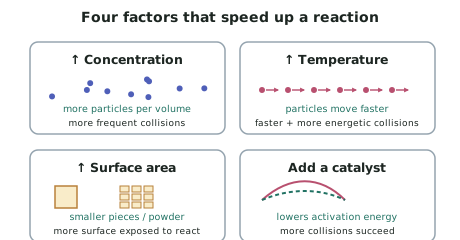
Each is explained by collision theory, and three of the four work the same way.
Concentration
-
Increasing the concentration increases the rate.
-
A higher concentration means more particles in the same volume, so the particles are closer together.
-
They therefore collide more often — the collision frequency increases.
-
More collisions per second means more successful collisions per second, so the rate increases.
-
The energy of each collision is unchanged — concentration works purely through frequency.
-
For a gas, increasing the pressure does the same thing: it squeezes the same number of particles into a smaller volume.
Surface area
-
Increasing the surface area of a solid increases the rate.
-
Only the particles on the surface can be collided with — the ones inside a lump are unavailable until the outside has reacted away.
-
Breaking a solid into smaller pieces, or powdering it, exposes far more particles, so there are more collisions per second.
-
The mass can be unchanged and the rate still rises, because it is the exposed surface that matters.
-
This is why flour or custard powder can cause a dust explosion.
Temperature
-
Increasing the temperature increases the rate, and it does so in two ways at once:
- Particles move faster, so they collide more often.
- Particles have more energy, so a greater proportion of collisions has at least the activation energy.
-
The second effect is much the larger, and it is the one that earns the mark.
-
A rise of only 10 °C roughly doubles the rate of many reactions — far more than the small increase in collision frequency could explain on its own.
-
Raising the temperature does not change the activation energy. The barrier is the same height; more particles can now get over it.
Catalyst
- A catalyst increases the rate without being used up.
- It provides an alternative reaction pathway with a lower activation energy.
- With a lower barrier, a greater proportion of collisions has enough energy, so the rate increases.
- Covered in full on the next page.
Which mechanism does each factor use?
| Factor | More frequent collisions | Greater proportion with enough energy |
|---|---|---|
| Concentration ↑ | ✓ | ✗ |
| Surface area ↑ | ✓ | ✗ |
| Temperature ↑ | ✓ | ✓ — the main effect |
| Catalyst | ✗ | ✓ |
- This table is the whole page. Reproduce it and explain why, and you can answer any rate question in the standard.
Worked ExampleComparing two factors
Magnesium ribbon reacts with hydrochloric acid. Explain, in terms of collision theory, what happens to the rate when (a) the concentration of the acid is doubled and (b) the temperature is raised from 20 °C to 40 °C.
(a) Doubling the concentration
Step 1 — What changes at the particle level. There are now twice as many acid particles in the same volume, so the particles are closer together.
Step 2 — What that does to the collisions. With more acid particles in the same space, they collide with the magnesium surface more often — the collision frequency increases.
Step 3 — The effect on the rate. The energy of each individual collision is unchanged, so the proportion that succeeds stays the same. But there are more collisions per second, so there are more successful collisions per second.
The rate increases.
(b) Raising the temperature from 20 °C to 40 °C
Step 1 — What changes at the particle level. The particles have more kinetic energy, so they move faster.
Step 2 — What that does to the collisions. There are two effects:
- Moving faster, the particles collide more often — collision frequency increases.
- Having more energy, a greater proportion of collisions has at least the activation energy.
Step 3 — Which effect matters more. The second is by far the larger. The rise in collision frequency is modest, but the increase in the fraction of collisions with enough energy is substantial — which is why a 20 °C rise can increase the rate several-fold.
The rate increases considerably.