Le Chatelier's principle
The principle
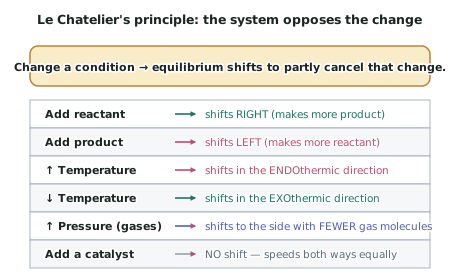
If a change is made to a system at equilibrium, the position of equilibrium shifts to oppose that change.
- The system responds to partly undo whatever you did.
- A shift right makes more product; a shift left makes more reactant.
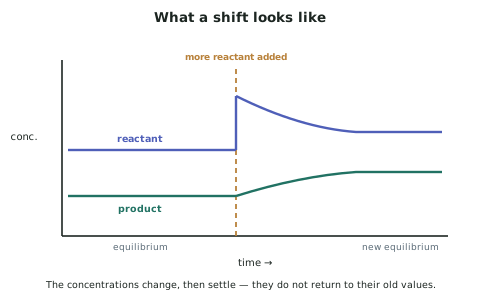
Concentration
- Add a substance → the system shifts away from it, to use it up.
- Remove a substance → the system shifts towards it, to replace it.
Worked through for :
- Add → shifts right, using up the added nitrogen and making more ammonia.
- Remove → shifts right, replacing the ammonia that was taken away.
- Add → shifts left, using up the added ammonia.
Temperature
Temperature is the one that needs the enthalpy change, so read it carefully:
- Raise the temperature → shifts in the endothermic direction (the one that absorbs heat, to oppose the rise).
- Lower the temperature → shifts in the exothermic direction (the one that releases heat).
Worked through for , :
-
The forward reaction is exothermic, so the reverse is endothermic.
-
Raising the temperature shifts left (endothermic direction) → less ammonia.
-
Lowering the temperature shifts right → more ammonia.
-
Temperature is the only change that alters the value of . Every other change shifts the position while leaving the same.
Pressure
- Only matters if gases are involved, and only if the number of gas molecules differs between the two sides.
- Raise the pressure → shifts to the side with fewer gas molecules (reducing the pressure).
- Lower the pressure → shifts to the side with more gas molecules.
Worked through:
- — 4 gas molecules on the left, 2 on the right. Raising the pressure shifts right.
- — 2 molecules each side. Changing the pressure causes no shift.
Catalyst
- A catalyst causes no shift at all.
- It speeds up the forward and reverse reactions equally, so the rates stay balanced.
- Equilibrium is simply reached sooner; the position and the yield are unchanged.
The method
- Identify what was changed.
- Work out which direction opposes it.
- State the shift as left or right.
- Say what happens to the amounts of reactants and products.
Worked ExampleApplying Le Chatelier's principle
For the equilibrium below, predict and explain the effect of (a) increasing the pressure, (b) increasing the temperature, and (c) adding a catalyst.
(a) Increasing the pressure
Step 1 — Count the gas molecules on each side.
- Left: 3 molecules of gas
- Right: 2 molecules of gas
The numbers are different, so pressure will have an effect.
Step 2 — Work out which direction opposes the change. Increasing the pressure is opposed by reducing the pressure, which the system achieves by moving to the side with fewer gas molecules — the right.
Step 3 — State the effect. The equilibrium shifts right, so more is formed and the amounts of and decrease. The yield of increases.
(b) Increasing the temperature
Step 1 — Identify the exothermic direction. is negative, so the forward reaction is exothermic and the reverse reaction is endothermic.
Step 2 — Work out which direction opposes the change. Increasing the temperature is opposed by absorbing heat, so the system shifts in the endothermic direction — the reverse, to the left.
Step 3 — State the effect. The equilibrium shifts left, so less is formed. The yield decreases.
Note also that temperature is the only change here that alters the value of — becomes smaller.
(c) Adding a catalyst
A catalyst increases the rates of the forward and reverse reactions equally, so the two rates remain balanced and there is no shift.
The position of equilibrium and the yield of are unchanged; equilibrium is simply reached more quickly.